Wondering how to be less awkward? The fix isn't more confidence, it's better calibration. Awkwardness usually comes down to a half-beat delay in reading social cues, not a fixed personality trait. Three moves help close that gap: pausing a beat before responding, using the eye-contact rule of thirds, and pointing your feet toward whoever you're speaking with. Practice matters more than charm, which is why recurring formats, like Timeleft's weekly dinners, work so well: they lower the stakes and compress the reps.
If you’ve ever been called awkward, by others or even yourself, then you've probably spent a good chunk of time Googling how to be less awkward and landed on the classic ‘just be confident’ advice… which, to be frank, has probably helped no one.
While there are many issues with this response, the most crucial one is that it quite literally isn’t true. You see, after three-and-a-bit years of facilitating human connection IRL, we’ve seen that the causality actually runs the other way:
You don’t need confidence to connect, you need to connect to build confidence
In addition to this, it’s not very practical advice either. It offers no clear direction or actionable next step whatsoever, which, more often than not, leaves people feeling even more stumped as to how best to face their situation than they did before.
Here at Timeleft, we believe that the biggest enemy to showing up is comfort zones, or the general unwillingness to put oneself in any uncomfortable situations. And for anyone who believes they're socially awkward, this barrier is even bigger because:
The higher the awkwardness = the higher the perceived discomfort
If this has all resonated so far, then you’re in luck. Because we're here today with some practical, actionable advice for feeling less awkward socially. And yes, we might be a little biased, but we also happen to have a product that's pretty great at taking the edge off.
Will every dinner be a home run? Nope. There'll be awkward ones, and people who just don't click with you. But the good nights outnumber the bad, by a long shot.
“Joining Timeleft is a must-try experience! I was a little nervous for my first dinner but the group I was with really helped me relax and shared amazing stories. Not going to lie, there will be awkward dinners and people that don't suit you. However, the good experiences way outnumber the bad. I've gotten to try restaurants I had never heard of and I have never met this many people in such a short time.”
— Allan Mulder (5★, AU)
“Timeleft is an amazing app that tackles one of the biggest challenges of modern society – forming meaningful friendships as an adult. It takes the awkwardness out of meeting new people by organizing a reserved dinner for you and a group of strangers every Wednesday. The concept is simple yet genius: no endless messaging, no pressure to plan, just show up, share a meal, and connect.”
— Peace-Y (5★, US)
Before we get into the guide, let's clear up a couple of things about awkwardness in general first. Because the ‘just be confident’ crowd got one thing very wrong: awkwardness isn't a personality trait you're stuck with forever. It's more like a timing issue, and once you see it that way, it stops feeling so permanent.
Awkwardness is a calibration issue, not a character flaw
That awkward pause you keep replaying in your head? It’s not a personality problem, it's a timing thing.
Psychologist Joshua Clegg termed this the half-beat delay – your brain often processes what someone just said or did a beat after it actually happens. It’s not about being ‘slow’ per se, you're just working with delayed information. By the time you're back in real time, the moment's already moved on and your reply lands a fraction late. Consequently, the whole exchange feels slightly off. Add in the fact that you're also busy monitoring how you're coming across (a lot of mental multitasking for one conversation), and it's no wonder things feel clunky and, well, awkward. The interaction might look completely smooth from the outside, it just doesn't feel that way from inside your own head.
And once the conversation's over, the story in your head tends to get worse before it gets better. Researcher Erica Boothby calls this the liking gap: the tendency to walk away from a conversation convinced the other person liked you less than they actually did. Boothby et al. (2018) found this pattern again and again, in lab settings, at workshops, even among college roommates months into living together. It happens because you're stuck replaying your own awkward moments (the pause, the weird joke, the thing you wish you hadn't said), while completely missing the positive signals the other person was giving off the whole time.
Put those two things together, and you get a pretty clear picture. You're not bad at socializing. You're just reacting a half-beat late, then grading yourself on a curve nobody else is using.
The calibration moves that actually work
If awkwardness is a timing issue, then the fix isn't a personality transplant – it's a handful of small adjustments that help you catch up to the moment you're actually in. And the best part is that none of these require you to become a different person.
The conversation-pause rule (let one beat pass): Most awkward interruptions happen because you jump in a half-second too early, still catching up to what the other person said. Before you respond, let one full beat pass. It might feel like an eternity in your head, but it just looks like you're actually listening.
The eye-contact rule of thirds: Constant eye contact reads as intense, and none at all reads as disinterested. Aim for somewhere in between, holding eye contact for roughly a third of the conversation, breaking naturally when you're thinking or the other person is talking at length. It's a small adjustment that makes you look calibrated instead of like you're either staring or avoiding.
The body-orientation rule (point your feet at who you are talking to): Your feet give you away before your face does. Angling your body, and specifically your feet, toward whoever you're talking to signals engagement, even if you haven't said a word yet. Turned away, even slightly, and it literally reads as one foot out the door.
How to recover when you say something weird
Since we're all human and not robots, there are still guarantees of awkwardness finding its way into our interactions. We’ve grown to welcome it though, because we’ve noticed that awkwardness is always a sign that something genuine is about to form… it's also almost always followed by shared laughter, and who doesn’t enjoy a good laugh? But if you do want to arm yourself with a backup plan should something extremely awkward slip out by mistake, use these:
The named-referent move (“to your point about X”): If a conversation's drifted off track, or you've just said something that landed a little strangely, this is your reset button. Referencing something specific the other person said earlier (“to your point about X...”) signals you were listening, pulls the conversation back to solid ground, and subtly moves everyone past the awkward beat without acknowledging it happened at all.
The recovery move: Said something weird? Don't apologize for it three times or try to explain your way out. Just name it, lightly, and move on. Something as simple as “well, that came out weirder than it sounded in my head” does more work than you'd think. It signals self-awareness, gives the other person permission to laugh, and closes the moment instead of dragging it out. The people who recover fastest from awkward moments aren't the ones who never have them, they're the ones who don't let a two-second wobble turn into a two-minute apology tour.
Noticing your own awkwardness in real time (without spiraling)
The second part is the hard bit, because the natural instinct is to try harder, overcorrecting and monitoring every word before it leaves your mouth. Which, ironically, is exactly what makes it worse.
Psychologist Daniel Wegner's ironic process theory explains why. The more you try to suppress a thought or behavior (like “don't be weird”), the more mental effort you spend checking whether you're succeeding, which keeps that exact thing front and center in your mind. It's a bit like telling yourself not to think about a pink elephant – the instruction itself keeps the elephant in the room.
The fix is less effort, not more. Notice the moment, let it register, and keep going. A brief “huh, that was a bit weird” thought, followed by nothing, does far more good than a frantic scramble to fix it mid-sentence. It's only awkward for as long as you decide to stay in it.
Why practice matters more than charm
The people who seem effortlessly smooth in social situations aren't necessarily the most naturally charming, they're the most calibrated. They've simply had more reps, more conversations, more chances to close that half-beat gap we talked about earlier, until it barely registers anymore. This matters because it reframes the whole problem. If awkwardness were a fixed trait, there'd be nothing to do about it except hope for the best. But if it's a calibration issue, it's a practice problem, which means it's solvable.
The fastest way to get more reps in is to put yourself in recurring social contexts, not one-off ones. A single big night out gives you one shot to get it right, which raises the stakes and, ironically, makes you more awkward, not less. A weekly dinner, a running club, a regular class, these lower the stakes because you know you'll be back next week regardless of how tonight goes.
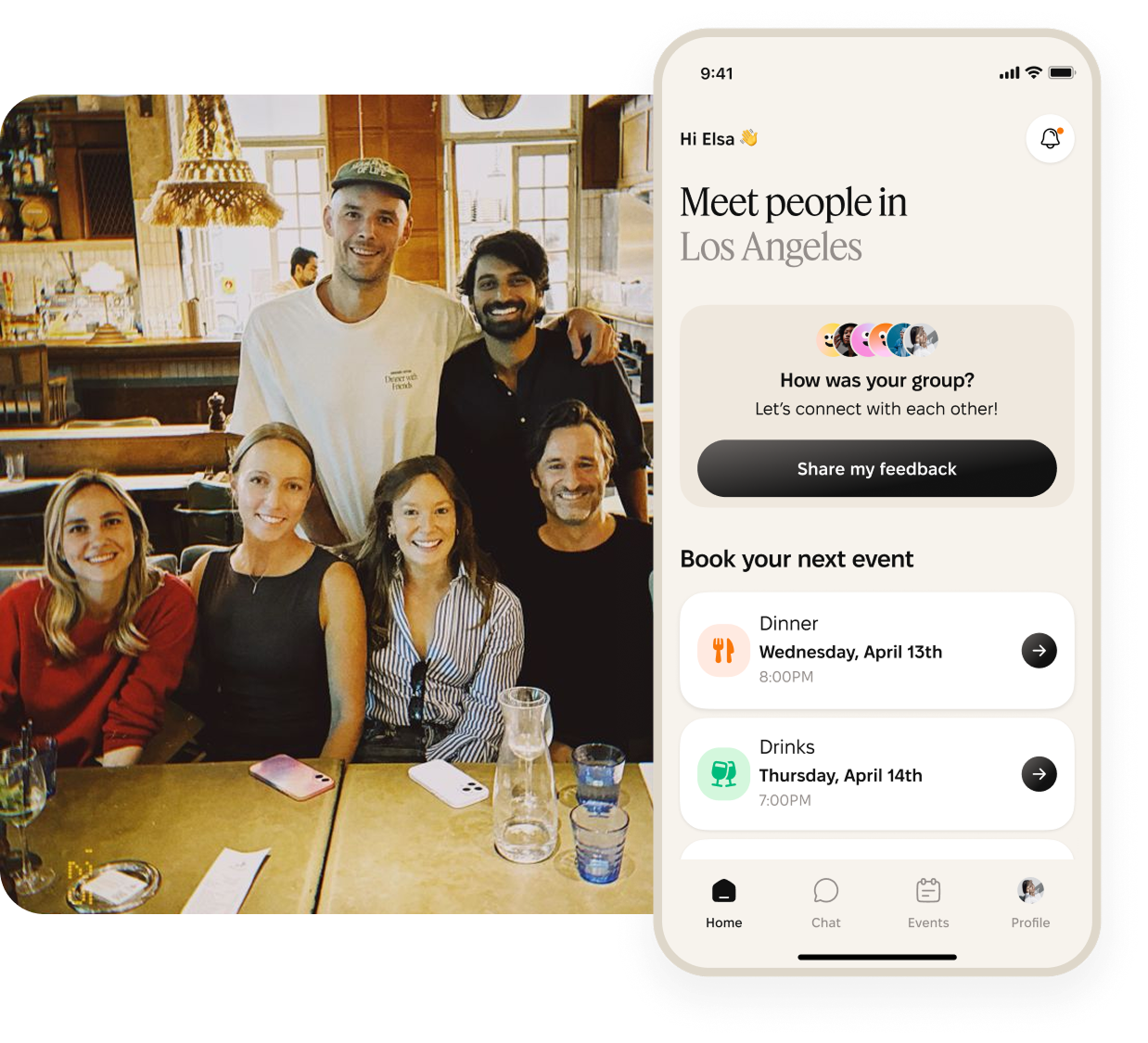
That's part of the thinking behind Timeleft's format:
Weekly dinners with a small group mean you're not trying to make a lifelong impression in one sitting. You're just showing up, again, and letting the calibration happen naturally over time.
The bottom line on social awkwardness
So, no, you don't need to ‘just be confident.’ You need reps, a little patience with yourself, and maybe one less internal audit per conversation.
The wheel we mentioned earlier? It stops turning the moment you stop waiting to feel ready and start showing up anyway. Confidence was never the prerequisite, it's the byproduct.
And, of course, awkward moments will still happen. And that’s fine. They're simply proof you're actually in it, not performing from the sidelines. Ready to put these into practice? Become a member and show up to a Timeleft event this week.
FAQ
Why am I so awkward?
You're probably not, at least not in the way it feels. Most self-described awkwardness comes down to a half-beat delay in processing social cues, plus the liking gap, which makes you underestimate how well things actually went. It's a timing issue, not a character flaw.
How to be less socially awkward?
Since awkwardness is mostly a calibration problem, it responds to practice the same way any timing-based skill does. The people who seem least awkward aren't naturally gifted, they've just had more reps.
How do you overcome social awkwardness?
If you're looking for how to overcome social awkwardness, there's no single fix, but a few tips make the biggest difference: pausing a beat before responding, adjusting eye contact, orienting your body toward the person you're speaking with, and putting yourself in recurring social settings so you get more practice at lower stakes.
Is being awkward genetic?
Not directly. Some people are naturally more sensitive to social cues or slower to process them in real time, which can look hereditary, but awkwardness itself is a calibration issue that improves with exposure and practice, not a fixed trait passed down.