The best apps to make friends in 2026 fall into four categories: structured IRL meetups, interest-based event discovery, algorithm-driven matching, and spontaneous social discovery. Research shows it takes roughly 50 hours together to become casual friends (Hall, 2018) - which means apps that get you into a room faster tend to produce friendships faster. There's no single best option for everyone, but Timeleft, which connects 3M+ people across 200+ cities over weekly dinners and meetups with five matched strangers, consistently leads for speed to real-life connection.
These days, it can feel easier to change careers, move cities, cross the finish line of a marathon, or even travel to the moon than it is to make new friends.
That might sound dramatic, but if you've ever downloaded an app, matched with a few people, and then... never actually met them, you know exactly what we mean.
The good news? There's now an entire generation of apps designed to fix this. From one-on-one matching to group dinners with strangers, each one tackles a different stage of friendship.
As for which one actually works? We did some research to find the best apps to make friends in 2026. Here's what we found.
Why do we even need these apps?
Figuring out how to make friends as an adult has become one of the most pressing modern challenges - and the numbers back this up.
The U.S. Surgeon General has declared loneliness a public health crisis, citing health effects comparable to smoking 15 cigarettes a day. The WHO Commission on Social Connection found that one in four older adults and one in seven adolescents globally experience meaningful loneliness. And since 1990, the share of Americans reporting zero close friends has quadrupled, according to the Survey Center on American Life.
The friendship infrastructure that used to work - school, shared housing, office proximity - has quietly crumbled. And apps have stepped in to try and fill the gap.
As TechCrunch noted, this space has grown rapidly, driven by rising demand for more intentional ways to meet people - with millions downloading apps built specifically for friendship and real-world connection.
But here's the key insight:
While all of these apps are part of the same friendship-app wave, they solve very different problems.
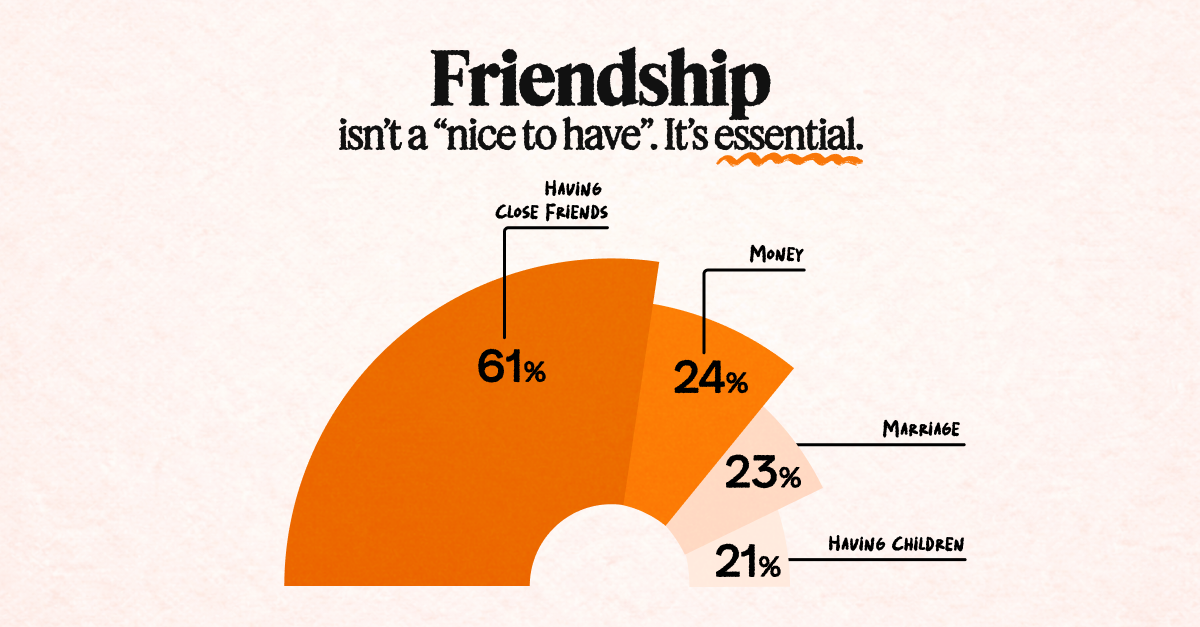
Friendship isn't a "nice to have". It's essential.
61% of adults say having close friends is extremely or very important to living a fulfilling life - far higher than those who say the same about money (24%), marriage (23%), or having children (26%). (Pew Research Center, 2023)
The 4 types of friendship apps
Most modern friendship apps fall into one of these four categories:
1. Structured IRL meetups
These apps are built for people who want to skip the chatting and go straight to meeting up in real life. They organize curated gatherings - like small group dinners or social runs - and handle all the logistics so you don't have to. Timeleft and Thursday both sit in this category.
2. Interest and event discovery platforms
These apps help you find things to do and meet people through shared activities. Great if you already know what you enjoy and want to meet people around it. Think Meetup or WeMeet.
3. Algorithm-based friend matching
Apps like Bumble BFF and Les Amis match you with people based on personality, interests, or life stage - similar to a dating app. A solid choice if you prefer starting with conversation before meeting.
4. Location-based or spontaneous social discovery
Designed for exploration and low-pressure interaction, these apps show who's nearby or what's happening right now. Locals is the clearest example.
Most apps overlap a little, but each has a clear primary strength. Understanding which type fits you is half the battle.
How we evaluated each one
Rather than ranking every app on a single scale, we looked at what actually shapes your experience:
How you meet people - Is it messaging first, joining a group activity, or showing up to a dinner? This often determines whether anything happens at all.
Structure vs. flexibility - Some apps handle everything; others leave it up to you. Depends on how much effort you want to put in.
Speed to real-life connection - How long from download to actual in-person meeting? This is where most apps lose people.
Type of connection - One-on-one friendships, group dynamics, or casual social circles?
Availability and consistency - Does the app actually run in your city, and does it run regularly?
Different apps, different outcomes
The biggest takeaway from comparing these apps is straightforward: there's no single "best" one - only the one that fits how you want to meet people.
Some apps are great for browsing and matching. Others are better for joining activities and communities. And a handful are designed for actually sitting down with new people and talking. Understanding this difference is what helps you choose the right one, instead of downloading five apps and hoping one works.
A quick note from us
We're the team behind Timeleft, the Friendship App that's helped 3M+ people in 200+ cities around the world make friends IRL over dinner, coffee, drinks, and the occasional run. Nearly 80,000 New Yorkers alone have booked a gathering.
We genuinely believe that real-life interaction is the fastest path to meaningful friendship - research on dinner with strangers bears this out. But we're also fully aware it's not one-size-fits-all.
That's why we made this guide: to help you find the app that actually fits you. We'll be straight about where Timeleft shines, and where one of the others might suit you better.
Let's get into the 9 best apps for making friends in 2026.
Quick comparison: 9 best apps to make friends in 2026
The 9 best apps to make friends in 2026
1. Timeleft
Best for: People who want a clear, low-effort way to meet new people IRL and actually make friends
How it works:
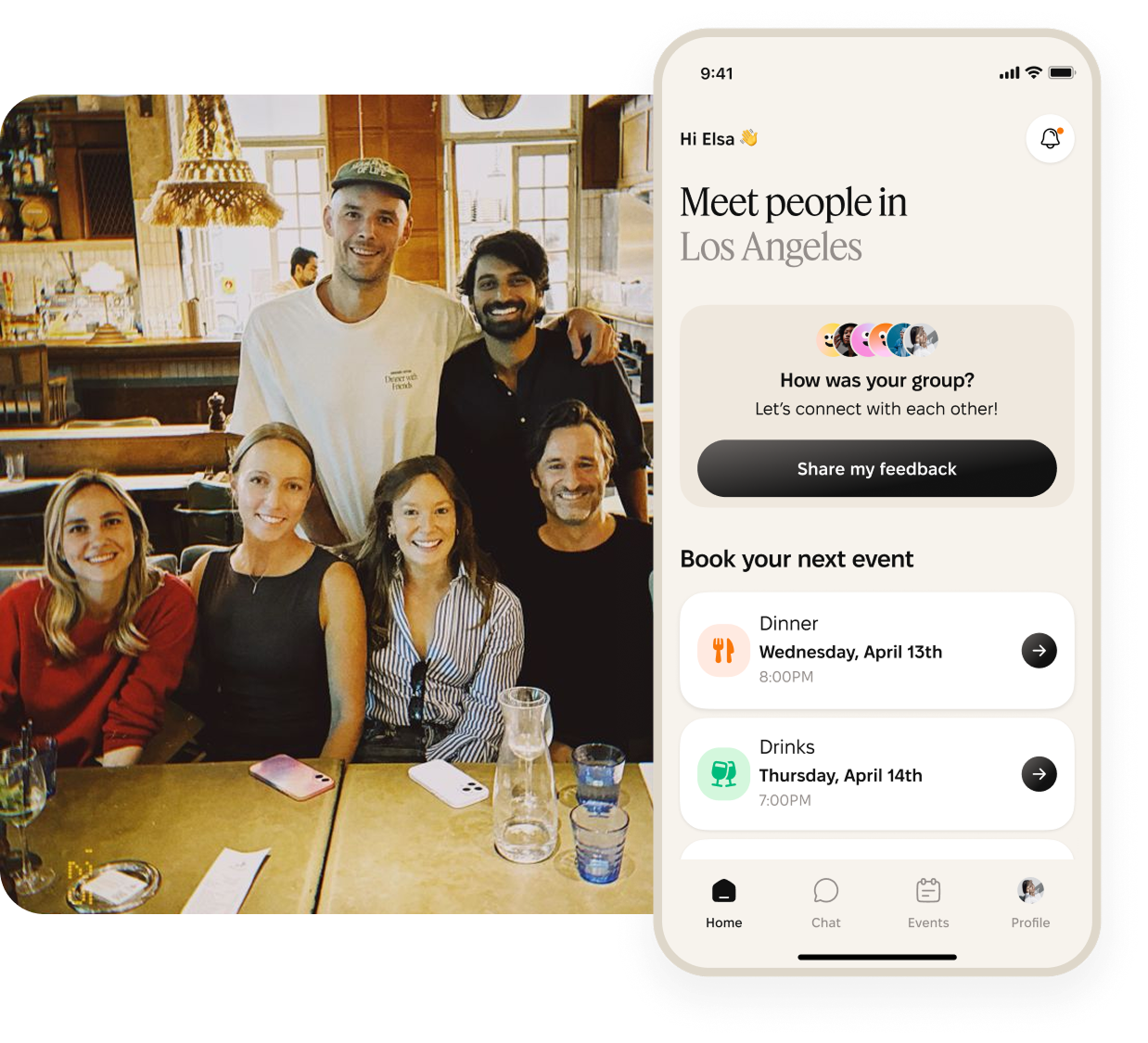
At Timeleft, we match you with a group of five strangers based on personality and interests, and you meet them in real life over dinner, coffee, drinks, or a run. No bios to scroll through, no endless messaging - just show up and meet your people. The weekly format means you're building the kind of repeated exposure that research links to real friendship formation: Hall's 2018 study found it takes roughly 50 hours together to become casual friends, 90 hours for a genuine friendship, and 200+ for a close bond.
Strengths:
Removes the awkward "endless messaging" phase entirely
Highly structured, low effort - all the logistics are handled for you
Strong focus on real-life connection from day one
Works well for people who want depth without the dating-app pressure
Consistent weekly rhythm across 200+ cities worldwide
Limitations:
Not yet available in every city
Less control over who you're matched with
The weekly format may not suit every schedule
Timeleft sits at the intersection of dating-app convenience and real-life friendship outcomes - making it a natural fit for anyone who wants to turn strangers into actual friends. Ready to give it a go? Book your first Timeleft dinner and meet new people this week.
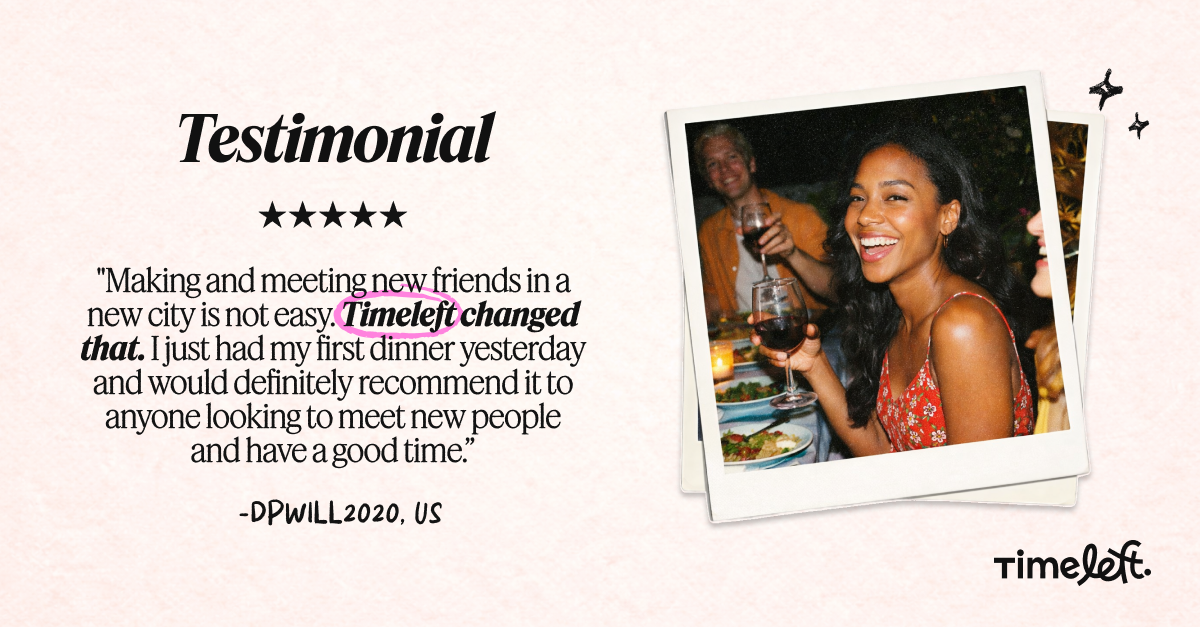
"Making and meeting new friends in a new city is not easy. Timeleft changed that. I just had my first dinner yesterday and would definitely recommend it to anyone looking to meet new people and have a good time."
dpwill2020 (5★, US)
2. Bumble BFF
Best for: One-on-one friend matching with a chat-first, familiar interface
How it works:
Bumble BFF is the friendship mode of the Bumble dating app, launched in 2016 as one of the first major platforms to formally pivot toward platonic connection. You swipe through profiles, match with potential friends nearby, and chat before deciding to meet up. It's dating-app mechanics applied to friendship.
Strengths:
Familiar, easy-to-use interface for anyone who's used a dating app
Large user base in most major cities
Good for one-on-one friendships with flexible scheduling
More control over who you talk to before committing to a meetup
Limitations:
Heavy reliance on messaging - many matches never turn into actual meetings
The transition from match to IRL requires effort from both sides
Chat quality varies; the app can feel like a social media feed
3. Meetup
Best for: Large interest-based group activities and established communities
How it works:
Meetup connects people through shared interests - hiking, reading, language exchange, professional development, almost anything. Founded in 2002, it's one of the longest-running platforms for real-world social connection. You join a group, sign up for a gathering, and show up. With 65M+ members across 100+ countries and thousands of active groups running weekly, it's the broadest community in this space.
Strengths:
Enormous variety of interests and communities
Great for extroverted or activity-driven socializing
Low pressure - conversation happens naturally around the activity
Many groups have long histories and tight-knit regulars
Limitations:
Friendship depth depends heavily on event quality and group culture
Larger groups can feel impersonal - it's easy to show up and leave without connecting
Less consistent social outcomes than curated-dinner formats
4. Thursday
Best for: People who want a once-a-week, high-energy IRL social experience
How it works:
Thursday hosts one event per week, every week - curated IRL social gatherings in cities across the world. The focus is on meeting new people fast, in person, through a time-constrained format that creates a shared sense of occasion. Currently running in cities including London, New York, Paris, Brussels, and Toronto.
Strengths:
Strong emphasis on real-world interaction over messaging
Clear, time-bound experience - no lingering "when do we actually meet?"
High energy, social-first format that works well for outgoing personalities
Limitations:
Once-per-week cadence limits how quickly you can build on a connection
Availability varies by city; smaller markets may have thin crowds
More social-event-focused than deep-friendship-building by design
5. Les Amis
Best for: Women and LGBTQ+ members who want curated compatibility before meeting up
How it works:
Les Amis uses AI and identity-based preferences to match people with like-minded potential friends, often anchoring around shared values, interests, and life stage. It's a members-only community with a strong focus on safety and inclusion - gatherings tend to be intimate and thoughtfully curated rather than open to everyone.
Strengths:
Strong focus on compatibility and psychological safety
Inclusive by design - built around women and LGBTQ+ communities
Curated event formats help members move from match to real-life more naturally
Limitations:
Still relies on members taking initiative to meet offline after matching
Can feel slower to produce a connection than apps built around immediate IRL meetups
Smaller overall user base limits availability outside major cities
6. 222
Best for: People who want algorithmically curated social groups without needing to manage the experience themselves
How it works:
222 curates small social groups and gatherings based on personality traits, inviting members into organized hangouts designed to spark genuine connection. Think of it as a more personality-conscious Meetup - you're not browsing group activities and signing up; you're being matched into a curated group experience.
Strengths:
Strong group chemistry through algorithmic curation
Less random than open event platforms
Encourages real-world socializing from the outset
Limitations:
Availability and event frequency vary significantly by market
Less individual control over who you meet
The overall experience depends heavily on how well the curation works in your city
7. WeMeet
Best for: People who want friendships to form organically through shared activities and hobbies
How it works:
WeMeet connects people through group activities - from casual hangouts to structured hobby-based meetups. The idea is that shared activity creates natural conversation, which creates natural friendship. It's the digital equivalent of joining a running club or pottery class.
Strengths:
Natural conversation through shared interests reduces social pressure
Lower stakes than one-on-one matching
Good for people with a specific hobby or activity they want to share
Limitations:
Quality and frequency of activities depends heavily on your local market
Less structured than curated-dinner formats - more depends on your own initiative
Friendships can stay activity-specific and not develop beyond the shared hobby
8. After5
Best for: Working professionals who want light social expansion after the workday
How it works:
After5 focuses on evening social gatherings for working professionals, helping people connect outside of office environments through casual, city-based meetups. It's built around the reality that many adults have work friends but few real friendships outside of that world.
Strengths:
Tailored for working adults who already have full daytime schedules
Easy, low-commitment "after work" format
Casual environment that keeps the pressure low
Limitations:
More networking-adjacent than deep-friendship-building
Time-bound to evenings and weekdays - weekend socializers may find it thin
Less structured bonding experience compared to curated-dinner formats
9. Locals
Best for: People who want serendipity and exploration wherever they find themselves
How it works:
Locals shows you people and activities happening nearby, encouraging spontaneous meetups and real-time social exploration in your area. It's low-structure by design - the appeal is discovery rather than planning.
Strengths:
High spontaneity and flexibility
Great for exploring new cities or when you're traveling
Encourages discovery of local social scenes without committing in advance
Limitations:
Low structure leads to inconsistent outcomes - you get out what you put in
Harder to build deeper friendships from one-off spontaneous encounters
Can feel unpredictable compared to apps built around recurring formats
Which app actually helps you make friends?
There's no shortage of apps to make friends in 2026. The real challenge is figuring out which type of connection you're after - and then actually showing up.
If you're still figuring out what works for you, start with the format that feels most natural. If the idea of browsing profiles and messaging first appeals to you, Bumble BFF or Les Amis are solid starting points. If you want something activity-driven, Meetup has been running groups in most major cities for over two decades.
And if the idea of a small, relaxed dinner with five well-matched strangers sounds like something you'd actually enjoy - that's what we do. Timeleft was built on the belief that the fastest path to real friendship isn't an algorithm. It's a table.
If you're curious what it's actually like, you might find our piece on dinner with strangers worth a read. And if you're starting from scratch socially - new city, post-breakup, post-pandemic - know that this is exactly the situation we were built for.
Book your first Timeleft dinner and meet new people in real life this week.
Frequently asked questions
What’s the best app to make friends in 2026?
There’s no single best app — the right one depends on how you want to meet people. If you want to skip messaging and meet IRL right away, Timeleft or Thursday are your best options. If you prefer chatting first, Bumble BFF or Les Amis are better fits. If you’re activity-driven, Meetup has the broadest variety. The fastest path to actual friendship, though, consistently runs through real-life interaction - apps that get you in a room with people tend to work better than apps that keep you in a chat window.
Do friendship apps actually work?
They can - but it depends on the app and how you use it. The research is clear on what produces friendship: repeated, unplanned interactions in close proximity, over time (Hall, 2018). Apps that build that kind of structure in — like recurring weekly dinners or regular group activities — tend to produce stronger results than ones that put the burden of scheduling on the user. Apps where most interactions stay in-chat rarely turn into real friendships.
Is Bumble BFF gone?
No - Bumble BFF is still active as of 2026. It’s the platonic-friendship mode within the Bumble app, launched in 2016. While Bumble has periodically updated how BFF mode works, the feature remains available for people looking to match with potential friends rather than romantic partners. That said, the heavy reliance on messaging before meeting is a common criticism — many matches never progress to an actual meetup.
Are there free apps to make friends?
Most friendship apps offer a free version, though the best features are often behind a paywall. Bumble BFF and Meetup both have free tiers. Timeleft uses a subscription model - roughly the price of a couple of cocktails per month - which covers your weekly gathering, personality matching, and venue booking. The logic: if there’s no cost, there’s often no commitment, which is why free friendship apps tend to have lower show-up rates.
Is Timeleft a dating app?
No. Timeleft is The Friendship App - it matches groups of six strangers for weekly dinners, drinks, coffees, and runs in 200+ cities worldwide. There’s no swiping, no romantic matching, and no DMs. Everyone shows up to the same table at the same time. Some members do end up becoming close friends who introduce each other to partners, but the app itself is built entirely around platonic connection. It’s a common misconception worth clearing up - especially for anyone who’s hesitant about friendship apps because they feel like dating apps.
What’s the fastest way to make friends as an adult?
The fastest route is one that gets you into a room with the same people more than once. Research by Dr. Jeffrey Hall at the University of Kansas found that casual friendship requires roughly 50 hours of shared time, real friendship around 90 hours, and close bonds 200+ hours. Apps that build in repetition - weekly dinners, regular group activities, recurring meetups - accelerate this process significantly compared to one-off encounters or chat-based matching. If you want to go deeper on the science, our guide on how to make friends as an adult and our piece on ice breaker questions that actually open conversations are good places to start.
Timeleft is the Friendship App - connecting strangers over weekly dinners, drinks, coffees, and runs in 200+ cities worldwide. Join us this week.