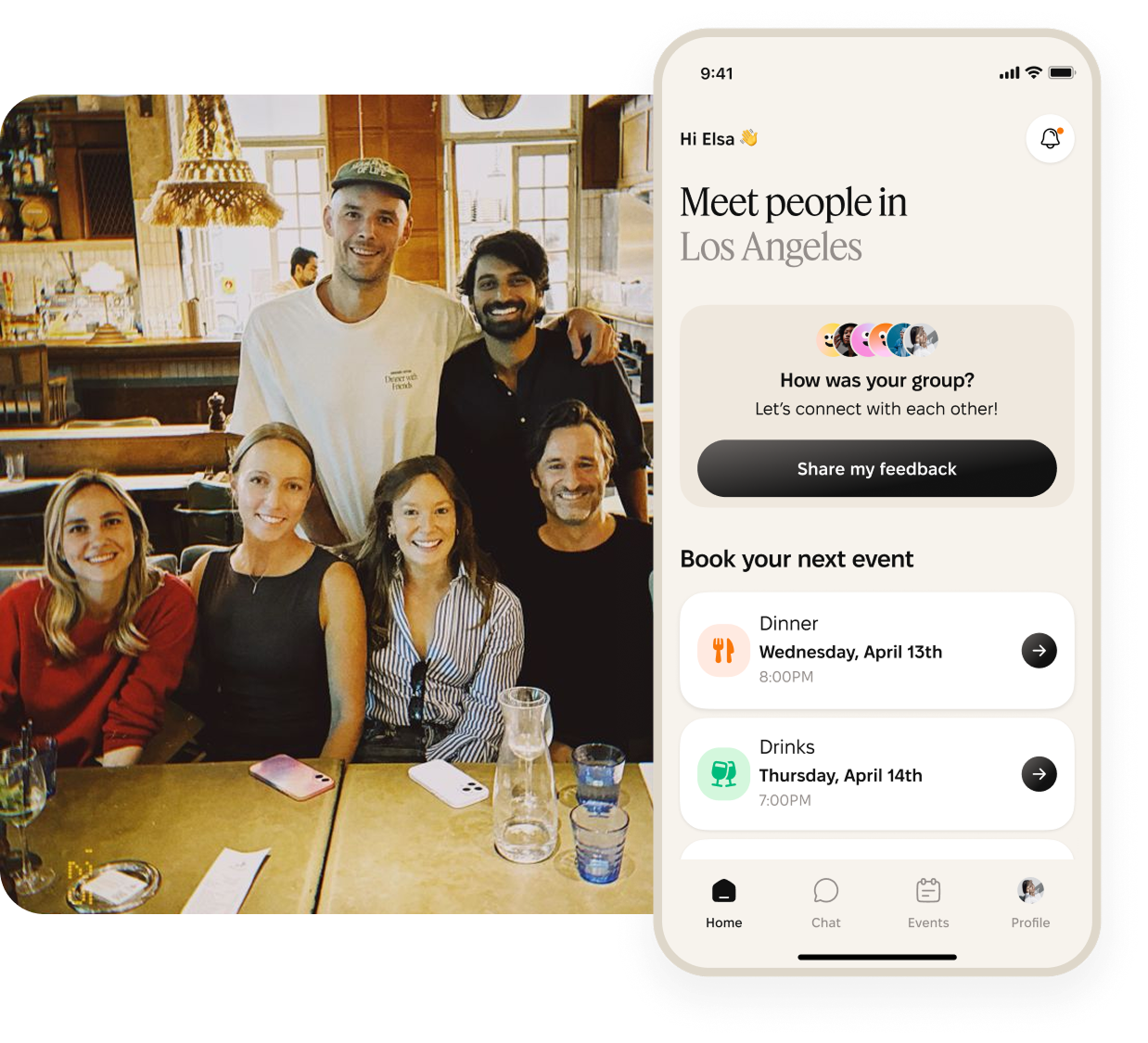
When six strangers sit down for dinner, there's an unspoken agreement. You'll show up, be open, and treat the people across from you with curiosity and respect. That agreement has always been at the heart of Timeleft – and until recently, it lived exclusively in the physical: at a restaurant, around a table, with a conversation that only the people in the room could hear.
Well, that changed. With the launch of group chats (now live worldwide), the conversation starts before anyone arrives. Before dinner, a chat opens with your tablemates. You can introduce yourself, share the pre-dinner excitement, ask what everyone's ordering, or just say a quick “hey!”. So far, that's happened over 16,000 times across 48 countries.
It's a small shift with a pretty meaningful upside.
Research on group dynamics consistently shows that even brief pre-interactions (a name, a passing joke, shared anticipation) reduce social anxiety and increase the likelihood of connection once people meet face to face. Quite frankly, the dinner gets better when the ice is already broken before you walk through the door.
But it also introduces a whole new group dynamic, with a digital space where your words don't just reach one person, they reach everyone at the table.
Why group chats need their own safety approach
A group chat changes the equation entirely. Your messages are visible to everyone who'll be sitting with you in a few hours' time. The pace is faster, and the audience is wider. A comment that might land well in a private exchange carries different weight when five other people are reading it before they've even met you.
That shift in exposure is exactly why we’ve built dedicated protections around group chats. Not as an afterthought, but as a core part of the feature from day one. Because the question was never should we moderate group chats… it was how do we do it properly.
Three layers, one principle
The safety architecture behind group chats works in three layers, all built around a single principle: protect the experience without policing the conversation. These protections apply for as long as the chat is open, before dinner and after.
Timeleft works because people feel free to be themselves. We're not interested in sanitising every interaction, but rather in catching things that genuinely harm people, and when content is automatically moderated, it happens within seconds.
→ Layer one: automated filtering. Every message in every group chat passes through real-time safety checks before it's delivered. Harmful content (spam, slurs, inappropriate content) is intercepted and blocked before it can reach anyone. This runs in the background, without anyone seeing it – ensuring the worst content never reaches your screen in the first place. So far, over 94% of group chats have never had a single message flagged.
→ Layer two: one-tap reporting. Automated systems catch a lot, but they don't catch everything. Things like tone and context matter, and sometimes a message that looks fine to a machine doesn't feel fine to the person reading it. That's why any user can report a message with a single tap. Long-press, tap "Report," and done. No forms*, no need to explain yourself, and the person you report will never know it was you.
*It’s important to note here that we deliberately removed every possible source of friction from the process. Reporting rates drop dramatically when systems require effort, and people who feel uncomfortable shouldn't have to fill out a form to say so.
→ Layer three: context-aware review. Every reported message is assessed in full conversation context, not in isolation. "You're going to regret that" after someone says they've never tried oysters is playful teasing – after an argument, it reads very differently. A single message doesn't tell the full story, the conversation around it does, which is why we take it into account.
We'd rather review a borderline message twice than wrongly penalise someone for something that wasn't harmful. False positives erode trust just as much as unaddressed violations do.
When reports lead to action
Our enforcement model follows the same tiered approach we outlined in our first post. The most serious violations result in immediate, permanent bans. Less severe issues are handled through structured warnings. And when a report doesn't reveal an actual violation? Nothing happens to the reported person. Less than 1% of group chats have ever had a member banned. Reporting is not a weapon. It's a safety net.
Casual conversation, even on uncomfortable or mature topics, isn't against our guidelines. Disagreement isn't a violation; neither is being awkward. We don't punish people for being imperfect humans at a dinner table, digital or otherwise.
A different kind of social space
Timeleft group chats are different by design. They exist to help six people who are about to share a meal feel a little more comfortable before they do. The chat opens leading up to dinner, and the meal gives the conversation a natural place to land. After dinner, the chat stays open so the connection doesn't have to end when the bill arrives. This is all guided by one sole purpose: to facilitate real conversation between real people, not content designed for an audience.
That design is intentional. The group chat is a bridge to a real-world experience, not a substitute for one (we are an IRL app after all). And it means the safety challenges, while real, are fundamentally different from those facing platforms built on infinite scroll and anonymous engagement.
One tap
We built group chats to make the first few minutes of a Timeleft dinner easier. We built the safety behind it to make sure that experience is protected. But the most important part of the system isn't the technology or the team, it's you.
If something in a group chat doesn't feel right (a message, a tone, a pattern) report it. You're not overreacting or creating drama. You're doing exactly what the system was designed for. Every report makes the next dinner safer for everyone, including people you'll never meet.
One tap. That's all it takes.
Héctor, Head of Customer Experience at Timeleft
Got questions about group chats? Visit our Help Centre for details on how group chats work and how they're moderated.