Having no friends as an adult is far more common than most people realize - 12% of American adults now report having zero close friends, a fourfold increase since 1990. It's not a personal failure; it's what happens when the shared-routine environments that used to create friendships by default (school, university, early jobs) disappear. The fix is structured, recurring exposure to new people. Research shows it takes roughly 50 hours of shared time to form a casual friendship (Hall, 2018). Start with one low-pressure weekly commitment - a class, a volunteer shift, or a Timeleft dinner where six strangers meet over a meal in 200+ cities worldwide.
At some point, maybe after a move, a breakup, or just the slow drift of adult life, a lot of people find themselves thinking the same thing: I have no friends.
Not "I have fewer friends than I used to." Not "my social calendar's a bit light." The real, heavy version - the kind that makes you wonder if something is fundamentally wrong with you.
If that's where you are right now, we want to be direct about something before we go any further: there is nothing wrong with you. Having no friends as an adult is not rare, not shameful, and not permanent. It's incredibly common. And it's almost always structural, not personal.
This guide will walk you through why adult friendships disappear, what the research says about rebuilding them, and a practical week-by-week plan for starting from zero. No toxic positivity, no "just put yourself out there!" platitudes. Just honest, useful steps.
Having no friends is more common than you think
If you're sitting with the thought "Why do I have no friends?", it's worth zooming out from the personal and looking at the bigger picture.
The numbers are striking:
This isn't a collection of sad facts for the sake of it. It matters because it reframes something important: having no friends as an adult isn't a rare personal failure. It's become a widespread structural reality.
The pandemic accelerated things, but the trend was already well underway. The real culprit? The slow, quiet disappearance of the environments that used to make friendship happen automatically.
Why adults lose friends (it's structural, not personal)
Earlier in life, friendships are supported by what researchers call built-in social environments. School, university, shared housing, and early-career workplaces create constant proximity. You see the same people every day, spend time together without planning, and friendships form almost by default.
As adulthood progresses, that infrastructure disappears. People move cities, change careers, start families, or grow in different directions. The social environments that once did the heavy lifting are gone, and nothing replaces them.
Three conditions that made friendship easy (and vanished)
1. Proximity. You were physically around the same people, day after day. No commute, no calendar invites - just shared space.
2. Repetition. You didn't have to plan to see someone again. Tomorrow, there they'd be.
3. Low-stakes interaction. Conversations happened casually. Nothing had to "mean something" for a bond to start forming.
When these three conditions are present, friendship grows almost by accident. When they're absent - which they are for most adults past their mid-twenties - it rarely happens at all. Not because people are less friendly, but because the architecture for friendship has been dismantled.
The isolation spiral
There's a compounding factor that makes things worse. Psychologist Mark Travers explains that prolonged social isolation changes how people relate to social situations. The longer someone goes without regular interaction, the more intimidating even small steps - a text, a group event, a conversation with a stranger - can feel.
This creates a feedback loop: loneliness makes it harder to do the things that would reduce loneliness. Breaking that loop requires not more willpower, but the right kind of environment - one that removes the pressure of having to initiate everything yourself.
How long it actually takes to make a friend
One of the most useful things to know when you're starting from zero is that friendship is slow, and that's completely normal.
Hall's 2018 study, which tracked adults relocated to new cities, found clear thresholds:
~50 hours of shared time: acquaintance → casual friend
~90 hours: casual friend → real friend
200+ hours: real friend → close friend
Fifty hours sounds like a lot, but it's roughly equivalent to attending a weekly two-hour dinner for six months. The math is less important than the principle: friendship requires patient, repeated exposure. Not one magical conversation. Not an instant click. Just showing up again and again in the same place with the same people.
This is encouraging because it means the formula isn't complicated. It's just slow. And knowing that it's slow helps take the pressure off any single interaction.
How to rebuild your social life from zero (week by week)
The idea of rebuilding your social life from scratch can feel overwhelming. So don't think of it that way. Think of it as starting a rhythm - small, deliberate steps that compound over time.
Week 1: Take one tiny step
The first step is simply creating one opportunity for interaction. It doesn't need to be perfect or impressive. It just needs to exist.
That might mean:
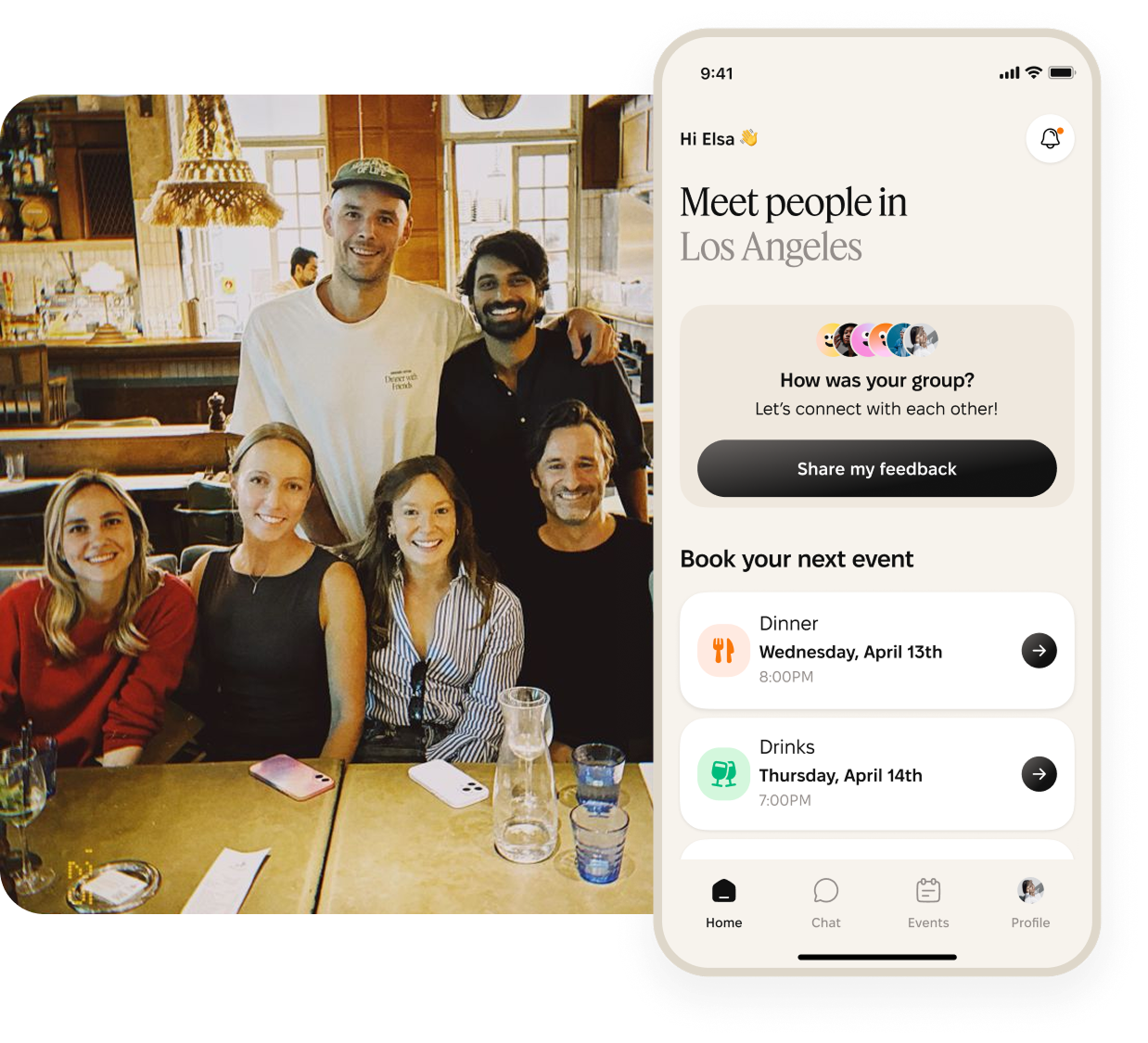
Downloading a social app designed for meeting people (not dating - friendship). Timeleft, the Friendship App, connects six strangers over weekly dinners, drinks, coffees and runs in 200+ cities worldwide. Over 3M+ guests have shown up, and the format is specifically designed so everyone comes alone - there's no awkward "joining an existing group" dynamic.
Booking one structured social event where showing up solo is the norm.
Spending an intentional hour in a "third space" - a cafe, library, park, or co-working space - where being around other people happens naturally.
The goal this week isn't to make a friend. It's to re-enter social space.
"If you're new to a city or looking to make new friends, it can be REALLY hard to start from zero. Timeleft takes all the sting out of that first step by grouping you with other people who WANT to meet people." - tnxw333, 5★, US
Weeks 2–4: Build consistency
Friendship rarely forms from a single interaction. The key ingredient is repeated contact.
Choose one or two environments and keep showing up. A weekly Timeleft dinner. A regular run club. A recurring class. The specific activity matters less than the consistency - familiarity builds comfort, and comfort is what makes real conversation possible.
A small challenge for yourself during this phase: have one genuine conversation each time you go somewhere social. It doesn't need to be long or deep. You're rebuilding a muscle.
Month 2–3: Deepen connections
Once you start seeing familiar faces, the next step is turning casual recognition into something more intentional.
If you enjoy talking with someone, suggest something specific: a coffee, a walk, or attending another gathering together. Be concrete about time and place. Make it recurring if you can.
Remember Hall's research: it takes about 50 hours to form a casual friendship. That's roughly one coffee a week for a year, or two dinners a month for six months. Nothing is "wrong" if a strong connection doesn't appear immediately. What matters is continuing to create opportunities for shared time - the one ingredient every budding friendship needs.
Month 3+: Let it compound
By this point, if you've been consistent, something shifts. You start to have people you look forward to seeing. Inside jokes form. Plans happen without the agonizing "is it weird if I suggest this?" deliberation.
This is where patience pays off. The friendships that stick are rarely the ones that felt electric from day one - they're the ones that grew slowly through repeated, genuine contact.
What if you have social anxiety?
For many people, "I have no friends" isn't just about circumstances. Social anxiety can make the process of meeting new people feel genuinely intimidating. Even small interactions can feel high-stakes, and the thought of attending events alone can be overwhelming.
This doesn't mean friendship is out of reach. It means the approach needs to be gentler.
What helps
Structured environments where you don't have to initiate. Timeleft dinners, for example, remove most of the hard parts: you don't plan anything, everyone comes alone, groups are small (six people), and ice breaker questions are built into the experience via conversation cards. The format does the social heavy lifting.
Small group sizes. Six people at a table is a different world from a room full of strangers. You can be heard without shouting. You can be quiet without disappearing.
Going once before judging. Social anxiety often makes the anticipation worse than the reality. One dinner - that's all. See how it feels.
That said, if anxiety feels overwhelming or prevents you from taking even small steps, professional support can help. A therapist or counselor can provide strategies tailored to your situation and help you break the isolation cycle safely.
The key point: social anxiety doesn't have to be a permanent barrier. It just means the first step needs to be smaller and the environment needs to do more of the work.
Tools for making friends from scratch
Starting from zero doesn't mean starting without resources. These are specifically designed to help adults create social connections:
Timeleft - the Friendship App. Weekly dinners, drinks, coffees and runs with six personality-matched strangers in 200+ cities. No existing friend group needed. Over 3M+ guests and counting. The conversation card format means you never have to worry about what to say. Book your first dinner.
Bumble BFF - swipe-based friend matching. Works best in larger cities with active user bases.
Meetup - recurring groups organized by interest (book clubs, hiking, language exchange, board games). Quality varies by city.
Run clubs and fitness communities - built-in repetition and endorphins. Low conversational pressure.
Volunteering - shared purpose creates natural bonding. Look for recurring commitments rather than one-off events.
Classes and workshops - pottery, cooking, improv, language courses. The shared learning curve creates camaraderie.
The common thread: pick something recurring and commit to showing up consistently. One-off events rarely produce lasting friendships. Recurring ones do.
What not to do (common mistakes)
Rebuilding a social life from scratch is hard enough without accidentally making it harder. A few patterns to avoid:
Don't try to fix everything at once. One commitment per week is plenty. Overloading your calendar leads to burnout and withdrawal.
Don't treat every interaction as an audition. Not every conversation needs to lead to a friendship. Some are just practice. Some are just pleasant.
Don't compare your timeline to anyone else's. Social media makes it look like everyone has thriving social circles. They don't. Most people are quietly struggling with the same thing.
Don't wait until you "feel ready." Readiness comes from action, not from waiting. Show up slightly before you feel prepared.
Don't dismiss structured social formats. "Meeting people through an app" can feel strange at first - until you realize that every person at the table showed up for the same reason you did.
FAQ
Is it normal to have no friends as an adult?
Yes. The Survey Center on American Life found that 12% of American adults report having zero close friends - a fourfold increase since 1990. Life transitions, relocations, remote work, and the decline of "built-in social environments" make this increasingly common. It's a structural issue, not a personal one.
Why do I have no friends?
Adult friendships fade primarily for structural reasons: moving cities, changing careers, starting families, working remotely, or simply growing in different directions. The social environments that once made friendship automatic (school, university, early workplaces) disappear, and most adults never replace them with anything equivalent. It's rarely about likability - it's about infrastructure.
How do I make friends when I have no friends?
Start with one recurring, low-pressure social commitment. A weekly class, a run club, a volunteer shift, or a Timeleft dinner where six strangers are matched for a shared meal. The key is repetition - research shows it takes about 50 hours of shared time to form a casual friendship. Show up to the same place consistently and connections will follow.
How long does it take to make friends as an adult?
Hall's 2018 study found it takes approximately 50 hours of shared time to move from acquaintance to casual friend, 90 hours for a real friendship, and 200+ hours for a close bond. That's roughly a weekly two-hour dinner for six months to cross the first threshold. Patience and consistency matter more than any single interaction.
Can you make friends in your 30s, 40s, or later?
Absolutely. The science of friendship doesn't have an expiration date. The ingredients remain the same at any age: proximity, repeated interaction, and gradual vulnerability. What changes is that you need to be more intentional about creating the right conditions, since they no longer come built into your daily routine.
What if I have social anxiety and no friends?
Social anxiety makes the process harder but not impossible. Start with structured environments that minimize the need to initiate - small group formats like Timeleft dinners (six people, conversation cards, everyone arrives alone) remove most of the friction. If anxiety feels overwhelming, consider working with a therapist while taking small parallel steps toward social re-engagement.
Why is it so hard to make friends after college?
College provided all three conditions that friendship research identifies as essential: proximity (shared campus), repetition (daily contact with the same people), and low-stakes interaction (casual conversations between classes). After graduation, all three disappear simultaneously, and most social environments adults encounter lack at least one of them. It's not that you've changed - it's that the environment has.
Is it too late to rebuild a social life?
No. It's never too late. The key is starting small and being patient. One recurring commitment per week, consistently maintained, can transform your social landscape within a few months. Many Timeleft members started from exactly this place - zero friends in a new city, or after a life change - and built meaningful connections through regular gatherings.
Starting over isn't starting from scratch - it's starting from experience
Here's the thing about having no friends as an adult: you're not actually starting from zero. You've had friendships before. You know what genuine connection feels like. You know what you value in another person. You have more self-awareness, more emotional maturity, and a clearer sense of who you actually want to spend time with.
All you're missing is the infrastructure - the place and the rhythm that lets connection happen naturally.
If you're ready for one small step, book a Timeleft dinner this week. No planning, no swiping, no bios. Just six strangers, conversation cards, and a meal. What happens from there is up to you - but at least you'll be in the room.
That's where every friendship starts.