Ah, here we have another remarkable creature to observe — the workaholic, striding into her natural habitat with purpose.
As is typical of this species, she’s clocking in to her 9 to 5 at 8:30 AM sharp, armed for success. The vintage designer blazer, perfectly ironed slacks, and scuff-free white sneakers are not just functional, they’re symbolic: she means business, but in a nice way. Clutched in her hand are the tools of the trade — an overpriced flat white and an iPhone, already pinging with notifications from her boss and the group chat.
Notice how she adapts seamlessly to her surroundings, performing the social rituals of the workplace with grace and ease. A greeting here, a polite smile there, yet her mind remains razor focused on the day ahead, ready to navigate the complex terrain of deadlines and expectations.
There is resilience in her stride. This is a creature that has evolved to endure long hours and high pressure environments, often placing the needs of the collective above her own. She is a model employee, perfection in action.
And yet, beneath the surface, there are signs — subtle and easily overlooked — of something missing.
Many productive hours later…
We return to observe this ambitious creature, now cozied up in her den after a long day of replying to emails, attending meetings, blitzing through her to-do list, and just generally setting a very high standard at the workplace.
It’s late, and she’s removed the armour that forms her workplace facade, returning to her most vulnerable state. It’s time for her to tend to the thing she’s had no time for today: her friendships.
She realizes with dismay that she has no idea what’s going on in the aforementioned group chat. The photos keep coming, along with inside jokes she doesn’t understand. To make matters worse, she’s missed one of the girl’s birthdays and they’ve gathered at their favorite watering hole to celebrate. Without her.
For someone who hates not being the best at everything, this feels like the ultimate failure.
The workaholic flops on to the bed in frustration, picking up her phone once again. Not to return the texts or make amends, but to doomscroll. Through the screen she observes her friends having fun together while she’s at home, feeling increasingly alienated and alone.
She angrily discards her phone and reaches for her laptop. Why get into it when avoidance is far easier? Plus, her career isn’t going to build itself.
*end scene*
The “illusion of perfection”
In our time observing this lovely workaholic, one thing has become clear: we are conditioned to see operational excellence as the route to success, something that has trickled down from our professional lives and seeped into our personal lives.
In the workplace, this is (mostly) okay. There are clear inputs and measurable outputs. Do good work, get good results. End of story.
But when it comes to friendship, well, that’s an entirely different ecosystem.
In friendship, there are no KPIs, no performance reviews, no bonuses for replying to a text on time — but we treat it like there are, like it’s something we need to get perfectly right every time. This makes sense, considering we’re operating in a culture that rewards hyper-productivity and excellence. We’re trained to believe that anything worth doing is worth doing well, and anything done imperfectly is a risk.
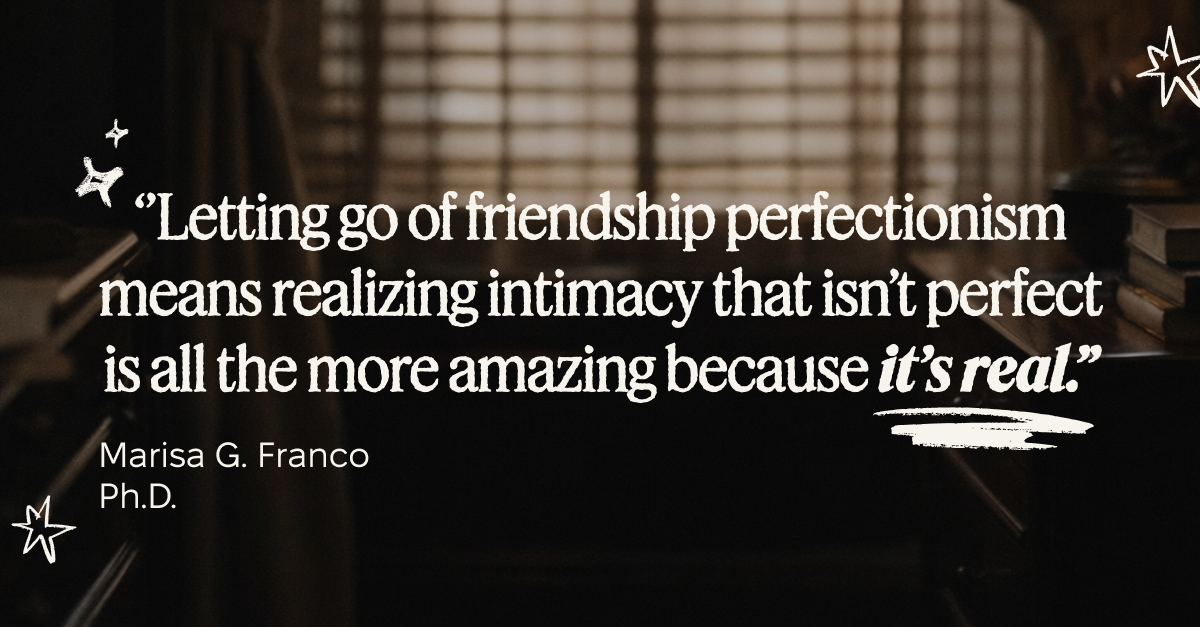
In Psychology Today, Marisa G Franco (Ph.D) refers to this phenomenon as the “illusion of perfection”, the idea that a friendship must be flawless to be secure.
And, as Kat Vellos, author of “We Should Get Together: The Secret to Cultivating Better Friendships”, notes, perfectionism manifests in friendship in different ways. It can often start with setting a high standard for yourself, and evolve into expecting nothing but the best from your friends, too.
For a perfection-seeking workaholic, this could look like:
Waiting until you have “proper time” to reply to a text, then never replying at all
Overthinking messages to the point that they never get sent
Cancelling plans because you’re too exhausted to show up as your best self
Quietly keeping score of who showed up for you as you’d expect — and who didn’t
This (incredibly human) instinct presents an interesting paradox — the behaviors you think will make you a better friend are actually the ones distancing you from the people you care about.
Because, as research into attachment theory and neuroscience shows, when every interaction feels like something you can get wrong, your nervous system stays on high alert, preventing you from forming truly intimate connections.
Friendship, as it turns out, does not thrive under performance pressure.
Moving forward, one imperfect step at a time
The good news, dear workaholics? You don’t need to become a better friend. You need to become a worse perfectionist. Let’s look at how you can begin to adapt.
1. Lower the bar (aggressively)
As we observed: when the workaholic is in her natural state, she’d rather not do something if she can’t do it well. This is unhelpful in friendship, because friendship isn’t built on grand gestures or perfectly timed catch ups. It’s more about the small, normal moments that add up over time.
In practice, this looks like sending a meme at a random time, dropping a “thinking of you ❤️” text, or sending a calendar invite for a coffee catch up. Small, quick, enough.
2. Show up at 60%
If you only show up when you’re fully energized and “on”, you won’t show up very often. So honestly, even less than 60% is fine — just show up.
The point is, you don’t have to be your best self to be a good friend. Go to dinner when you’re tired, reply when you’re not your sharpest, or admit you’ve had a long day and aren’t in the best mood. Turns out, the less-than-perfect version of you, the one that’s discarded the facade of “perfect overachiever”, is the one that’s easiest to connect with.
3. Redefine what being a good friend means
Often, this means looking away from the perfection presented to you on social media, and looking within. Ask yourself, what does a healthy and sustainable friendship look like? Is it a friend who always shows up, never puts in a boundary, or drops the ball? Or, is it someone who tries their best, maybe messes up, and still comes back anyway? Someone a bit more human, a bit more flawed. Someone like you ❤️
It’s not about trying harder. It’s about trying, full stop.
While these pointers are intended to help reframe the idea of what a “perfect friend” looks like, the truth is that “trying” doesn’t look the same for everyone.
For some, the barrier isn’t that they don’t care, or don’t want to try — it’s overthinking.
In those cases, it can help to remove the planning altogether.
Some people do this by stepping into environments where connection is already structured for them — like Timeleft, where small groups are brought together for dinner, coffee, or drinks, and the only real expectation is to show up.
See you soon, friend.