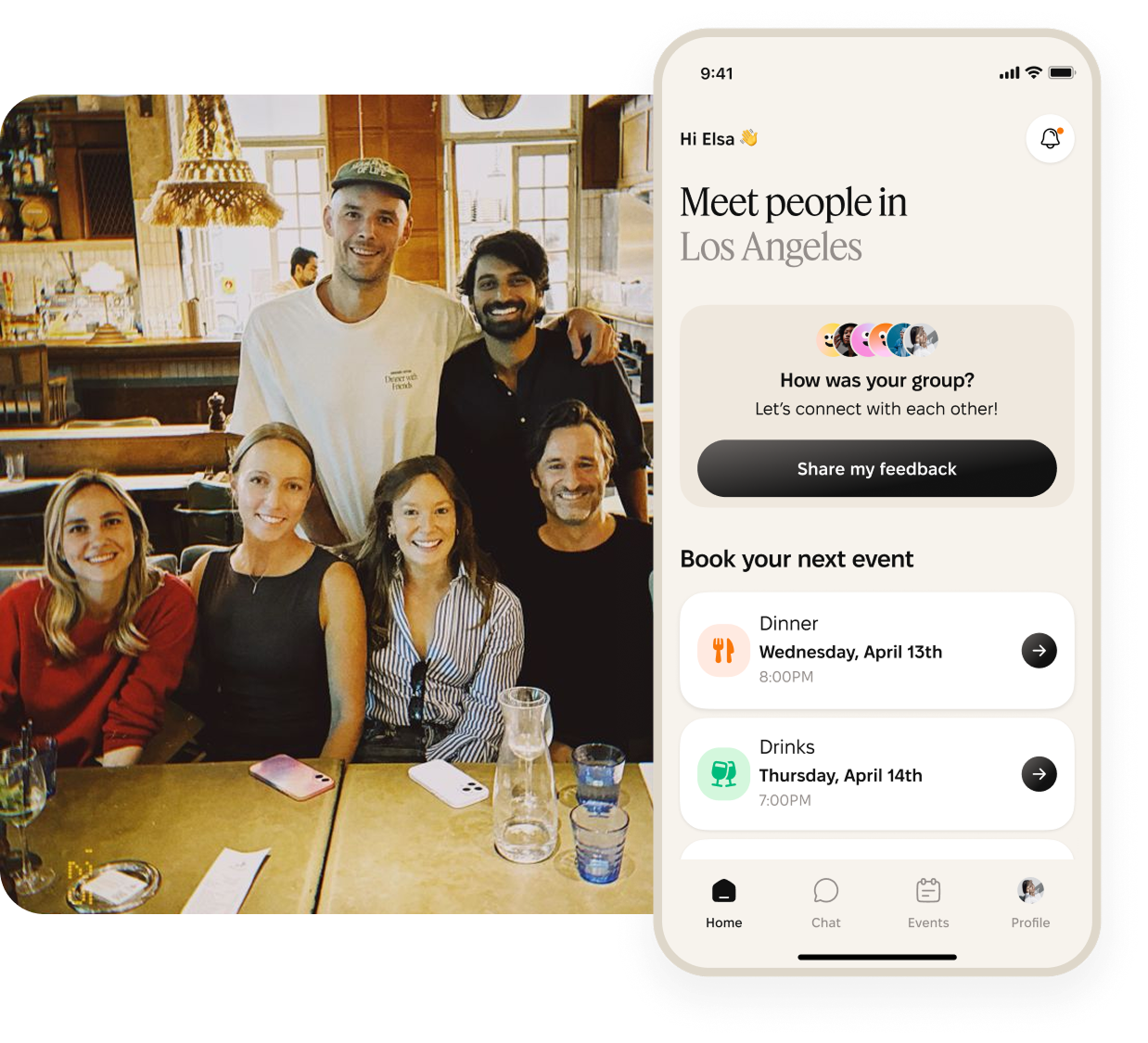
Most people listen to reply, not to understand, and that's the whole problem. Good listening isn't a personality trait, it's a set of moves anyone can learn: pausing before you respond, reflecting back what you actually heard, and asking one more curious question than feels natural. Timeleft's weekly dinners are a low-stakes place to practice all of it, since a table of new people tends to forgive an awkward first attempt.
We've all been there: mid-conversation, nodding along and saying "yeah, totally" at all the right moments, when suddenly you realize that you have absolutely no clue what the other person has been saying.
Not your finest moment, sure. But also not entirely a character flaw.
Think of it more as a "wiring" issue, the kind that clicks into place the moment your brain slips from listening to drafting your reply. This has a lot to do with the fact that the average person speaks at 175 to 200 words a minute, but the brain can process language at 600 to 1,000 words a minute, a gap researchers have pointed to for decades to explain why our minds wander even when we are actually trying to pay attention. That spare mental bandwidth goes looking for something else to do, usually planning what you'll say next.
However, unlike charisma or wit, listening is a skill you can practice any time, on purpose, with anyone. This guide walks through what the research says good listening actually is, why we're worse at it than we think (and getting worse for reasons bigger than any one of us), and five specific things to try at your next dinner, date, or catch-up call.
In this article: Convenience culture has made us lazier listeners Most of us aren’t listening, we’re just waiting for our turn You're better liked than you think (and listening is why) Reflectors VS fixers: the split that decides who gets told the truth Five moves to practice as soon as you can Silence isn't the awkward part, reaching to fill it is FAQ Where to actually practice this (you can start this week)
Convenience culture has made us lazier listeners
Listening is a skill, and like any skill, it gets built through repetition – small, unglamorous, everyday moments of paying attention to another person and working out what they mean. The trouble is, modern life has been slowly optimizing those reps away. A UNC Kenan Institute analysis describes a shift toward "extractive" habits, quickly scanning for the relevant data point and filtering out the rest, a mode that's efficient for managing information overload (a modern phenomenon most of us deal with on a daily basis) but is fundamentally the opposite of listening.
It shows up in small, physical ways too. Self-checkout machines, delivery apps, algorithmic recommendations: each one removes a tiny moment of friction that used to force a bit of conversation into existence. As one essay on the shift toward frictionless daily life put it, these are small, individually reasonable trade-offs that add up to "another erosive step in the gradual withering away of public interaction." None of them are dinner-table conversations on their own. But they were reps that strengthened our social muscles, and most of us aren't getting enough of those anymore.
The numbers back this up. Americans spent an average of just 2 hours 45 minutes a week with friends in 2021, down from 6.5 hours a decade earlier, while the average American now spends 7 hours a day on screens, and time spent at home has risen by roughly 1 hour 39 minutes a day since 2003. Even when we are talking to people, it's not always helping: research covered by The Conversation has found that the mere presence of a phone on the table, even switched off, is enough to measurably reduce the depth and quality of a conversation.
This is useful context when considering why listening feels harder than ever – and why we have to be intentional about practising it just like you would with any other skill.
Most of us aren't listening, we're just waiting for our turn
The term "active listening" was coined by psychologist Carl Rogers and Richard Farson in a 1957 paper for the University of Chicago, and their entire point was that listening is not passive. A real listener is working the whole time, trying to grasp both the facts and the feelings underneath them, not just waiting silently for their turn.
Stephen Covey picked up the same thread decades later in The 7 Habits of Highly Effective People, with Habit 5: “Seek first to understand, then to be understood”. His observation was blunt: most of us were taught to read, write, and speak, but nobody ever taught us to listen, so we default to listening with the intent to reply rather than the intent to understand.
That default is more common than most people would like to admit. In one survey, 96 percent of respondents said they were always or sometimes good listeners, while the same research found people retain only about half of what's said to them, measured immediately after the conversation ends. Almost everyone rates themselves as a good listener, but almost nobody actually remembers the conversation.
None of this means you're a bad friend – you're just a normal human whose brain hasn't been training the one skill that subtly determines whether people feel closer to you after talking, or just talked at.
You're better liked than you think (and listening is why)
Interestingly, even when people do connect, they walk away underestimating the value of that connection. Psychologists call this “the liking gap”. In a 2018 study published in Psychological Science, researchers found that after conversations, both strangers and college roommates systematically underestimated how much their conversation partner liked them and enjoyed their company. The gap showed up in five-minute chats and in relationships that had lasted an entire school year.
Listening appears to be one of the biggest levers on the other side of that gap. A large-scale meta-analysis by Avraham Kluger and colleagues, covering more than 400,000 participants, found a correlation of .66 between perceived listening and how much someone is liked, one of the strongest links in the research. The same body of work has found that good listeners are also seen as more competent and more trustworthy, not just more pleasant to be around.
Put those two findings together and you get a useful reframe: you are probably already liked more than you assume, and the fastest way to close that gap even further isn't a better personality or a funnier story. It's better listening.
Reflectors VS fixers: the split that decides who gets told the truth
When someone shares a problem, there are two very different instincts available: try to fix it, or try to understand it. Relationship researchers describe this as problem-solving listening versus empathic listening, and most of us default to the first without even noticing.
Fixing feels productive. It's also, frankly, more comfortable for the listener, since sitting with someone's discomfort without doing anything about it can feel like doing nothing at all. But a Psychology Today piece on listening habits points out that jumping to advice, reassurance, or a silver lining usually happens because it makes the listener feel better, not because the speaker actually asked for it.
The practical takeaway: before offering a solution, ask yourself which one this person actually wants. Most of the time, when someone tells you about a bad day, they're not handing you a problem to solve. They just want to be heard and understood.
Five moves to practice as soon as you can
None of this requires a personality transplant. It requires five specific, practicable moves, the same reps convenience culture has been subtly taking away, done on purpose instead.
1. The three-second pause
When someone finishes talking, resist the urge to fill the space immediately. A brief pause signals that you're actually processing what they said, not just waiting for your cue. It also protects you from the most common listening failure: responding to the first thing you heard instead of the whole thing.
2. The named reflection
Say it back, in your own words: "What I hear you saying is you're more frustrated with the timing than the decision itself." This single move, sometimes called reflective listening, does two things at once. It proves you were actually listening, and it gives the other person a chance to correct you if you got it wrong.
3. The curiosity question
Ask one more "tell me more about that" than feels natural. Most conversations end their exploration of a topic a beat too early, right when it was getting interesting, because the listener changes the subject or shares their own related story instead of digging one layer deeper.
4. The body-language match
Mirror the energy, not just the words. If someone leans in and lowers their voice to tell you something that matters to them, sitting back with crossed arms sends the opposite signal, even if your words are sympathetic. Matching posture and tone is a subtle but effective way of saying "I'm here, and I'm taking this as seriously as you are."
5. The feelings-validation move
Name the emotion under the story before you respond to the content of it: "That sounds like it was genuinely stressful," before moving on to logistics or advice. Validating the feeling first, separately from problem-solving the situation, is often what makes someone feel heard rather than just informed.
Silence isn't the awkward part, reaching to fill it is
Here's the most counterintuitive finding in all of this: the discomfort doesn't come from the quiet. It comes from what we do to escape it.
Research by Namkje Koudenburg and colleagues found that in the United States, it takes as little as four seconds of silence before a conversation starts to feel uncomfortable, a threshold that shifts by culture (Japanese speakers, for comparison, tend to stay comfortable for roughly twice as long). A separate set of experiments found that even a single brief silence in a group conversation was enough to trigger feelings of rejection and lowered belonging, even among people who weren't consciously aware the pause had happened.
The instinct that follows is to fill the gap fast, with a joke, a new topic, a reassurance, anything. But that scramble is usually what makes a pause feel awkward in hindsight, not the pause itself. A three-second beat of quiet after someone finishes speaking isn't a failure of conversation. It's evidence that you're actually thinking about what they said instead of racing to fill the air.
FAQ
What is active listening? Active listening is a communication approach, first named by Carl Rogers and Richard Farson in 1957, where the listener works to understand both the facts and the feelings behind what someone is saying, rather than passively hearing the words while waiting for a turn to speak.
How can I be a better listener? Practice five specific moves: pause for a few seconds before responding, reflect back what you heard in your own words, ask one extra curious follow-up question, match the other person's body language and tone, and name the feeling behind their words before addressing the content.
How do you listen actively in a conversation? Focus on understanding rather than replying. Resist the urge to plan your response while the other person is still talking, reflect back key points to confirm you understood correctly, and ask questions that invite them to keep going rather than steering the conversation toward yourself.
Why am I a bad listener? Most people aren't taught how to listen the way they're taught to read or speak, so the default becomes listening with the intent to reply. Add to that a daily life with fewer built-in chances to practice conversation than it used to have, and it's easy to drift into thinking about your own response instead of theirs. It's a common pattern, and a learnable one to change.
Where to actually practice this (you can start this week)
Reading about listening and practicing it are two different things, and most people never get a low-stakes place to try, which is part of the problem that convenience culture created in the first place. That's most of what a Timeleft dinner is, structurally: a small group of new people, no history, no old patterns to fall back into. Getting the named reflection wrong, or leaving too long a pause, costs you nothing with a table of people you've just met, which makes it a surprisingly good place to actually try these five moves out loud.
Ready to become a better listener? Subscribe to Timeleft, and start practising this week.