Third spaces – your local pub, corner café, community park – are quietly disappearing, and it's having a real effect on how connected we feel in our daily lives. This piece explores why these spaces matter, what's behind their decline, and why the vague sense of disconnection many people carry isn't a personal failing, it's a structural one. Most importantly, it covers what you can actually do about it, starting this week.
There’s work (or school), there’s home, and then there’s that place where you can just. . .be.
Your local pub with the warm and somewhat eclectic crowd of regulars. A park bench where you can sit and observe the dogs you know by name, while waving at their owners whose names are entirely beside the point. The corner café where the barista not only knows who you are, but also that you change your coffee order depending on your mood.
In other words, the places that feel like home, even when you’re miles from it.
They’re called third spaces, and if you’re thinking to yourself “wow that sounds nice, but I don’t have a local spot to call my own”, here’s the deal:
a. you’re not alone in feeling this way, and
b. that’s exactly the point
If you’ve also been wondering why your social life feels harder to maintain these days, no matter where you are, this may be part of the answer.
The thing is, third spaces have been in rapid decline over recent years, and for many reasons – the pandemic, the way convenience culture has optimized away the need to leave the house, and the collective increase in how much time we spend behind screens, among other things. Studies show that, in the UK alone, roughly two British pubs closed per day in Q1 of 2026. And, it’s not just the pubs. Cafés, community centers, local libraries, and corner bookshops all tell the same story.
But, there’s still time to do something about it, and it starts with showing up. Let’s get into it.
What exactly is a third space?
The term was coined by sociologist Ray Oldenburg in his 1989 book The Great Good Place. Oldenburg's idea was simple: beyond the first place (home) and the second place (work), people need a third – somewhere with no agenda, price of entry, or any pressure to be productive or impressive or anything in particular, really.
In his work, Oldenburg argues the important role that third spaces play in helping to form communities, as well as in maintaining healthy societies. They’re where neighbors actually started to feel like neighbors, where people with nothing obviously in common found themselves in conversation, where the informal bonds that hold a society together got reinforced, kind of like a social glue. It’s no wonder Oldenburg referred to them as “the anchors of human life”.
While third spaces come in many different forms – from the barbershop where the same argument about football has been running for 15 years, or the library where the librarian holds your favorite new Romantasy releases before they hit the shelf – they do share a few key qualities:
They're accessible (usually a low cost of entry, if any at all)
They're places you’d visit regularly
They're low-stakes
And, crucially, they create what researchers call "repeated, unplanned interaction", which is the exact conditions under which genuine connection tends to form.
For most of human history, this wasn't something anyone had to think about. It was just life. You kept showing up at the same place, saw the same people, and eventually a feeling of genuine community formed.
So what happened to them?
In short: a lot of things, all at once.
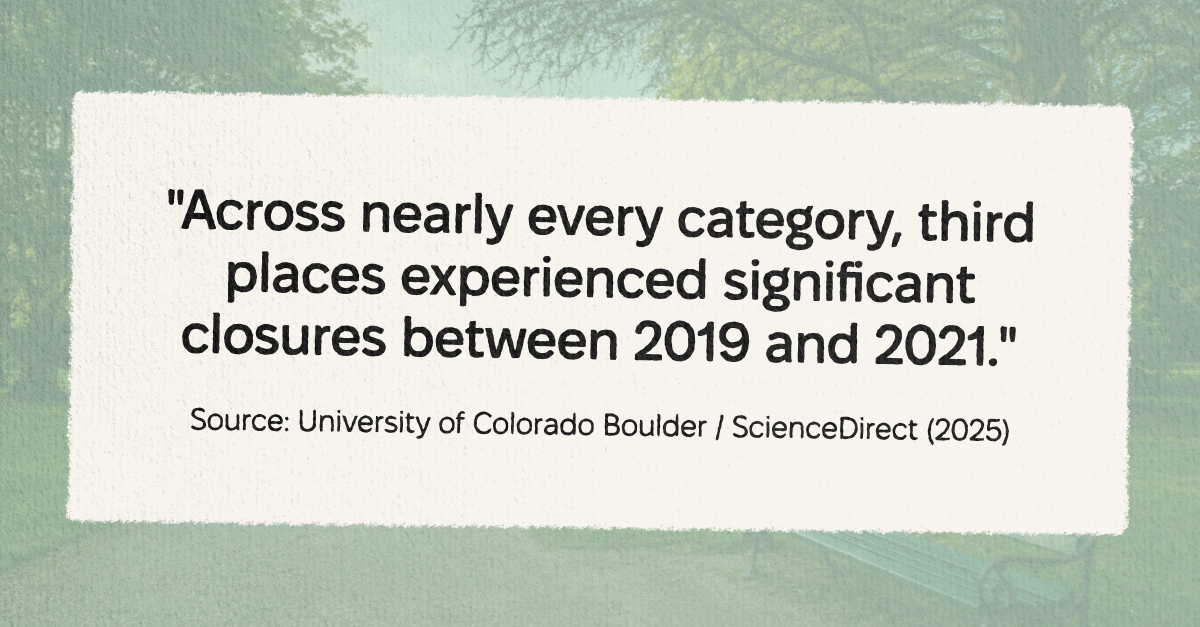
Rising rents and operating costs have made it harder for independent venues to survive, especially the small, slightly scruffy, and deeply beloved ones that never had the margins to absorb a crisis. The pandemic closed many of them, and not all of them came back. Those that did found that habits had shifted; people had gotten used to staying in, ordering in, and spending their evenings in a way that didn't require leaving the house.
Convenience culture did the rest. When everything from groceries to friendship to entertainment is available on demand from your couch, the friction of going somewhere starts to feel unnecessary. And once enough people feel that way, the venues that depended on casual, regular foot traffic start to struggle.
What makes this particularly worth paying attention to is that two declines happened in parallel – and reinforced each other. According to the American Time Use Survey, time spent with friends dropped 37% between 2014 and 2023. The venues were closing at the same time as people were already spending less time in them. One made the other worse, and together they produced something bigger than either could have alone: a gradual thinning of the social fabric that holds communities together, one closed café, one converted pub, one shuttered community center at a time.
What gets lost isn't just a venue, but also the infrastructure for accidental connection. As Associate Professor of Sociology Alicia M. Walker mentions in a Psychology Today piece titled We've Lost the Spaces That Foster Friendship, "Third places matter because they create the routine, low-stakes contact that keeps people from drifting into isolation." When they go, that contact doesn't automatically find somewhere else to happen. It just kinda. . .stops.
The gap where your local used to be
Many people carry a vague, but persistent sense that their social lives aren't quite what they used to be, or what they imagined they'd be by now. We were all sold the Friends dream, but the reality is that many friendships don’t really stick like that in adulthood. You could live in a city filled with interesting people, but still have an empty social calendar. It’s like everyone else got the “how to find your friendship group” manual, but that yours got last in the mail.
Yes, this instinct to make it personal is very real, but it’s not necessarily true.
In many cases, loneliness is less about emotion and more about environment – a predictable outcome of dismantling the spaces that once made repeated, in-person connection a part of one’s routine. This Psychology Today piece makes the case that what feels like a personal failing is often just a structural one. What if the reason it feels harder isn't you at all, but the fact that the places where connection used to happen organically have just. . .disappeared?
Without third spaces, opportunities for spontaneous, low-stakes connection shrink. As Light On Anxiety notes, everything becomes transactional or performance-based. Socializing stops being something woven into the week and becomes something that requires deliberate effort, scheduling, and a certain amount of emotional energy to initiate. For a lot of people, that barrier (however small it might look from the outside) is enough to keep them at home.
What you can actually do about it (it’s not complicated)
It comes down to one thing: showing up, consistently, to the same places. Here’s how you can start this week:
Become a regular somewhere
Pick one spot. It could be anything – a coffee shop, a gym, a park — but it should be a place that you feel some kind of attachment to. Then, keep going back, again and again and again. Better yet, go at the same time on the same day. Familiarity builds pretty quickly, and you don’t have to be particularly outgoing either. Simply showing up as you are is enough to ignite that spark of connection.
Find a recurring format that you love
It could be anything that brings together the same group of people around the same activity and on a predictable schedule – monthly book clubs, weekly running clubs, community sports leagues, local volunteer groups, or even religious or spiritual gatherings. The activity gives you something to talk about, and the repetition does the rest of the work.
Go where people are going out of their way to show up
A room full of people who all made a deliberate choice to be there is a fundamentally different social environment from a room full of people who just happen to be in the same place – everyone's already opted in.
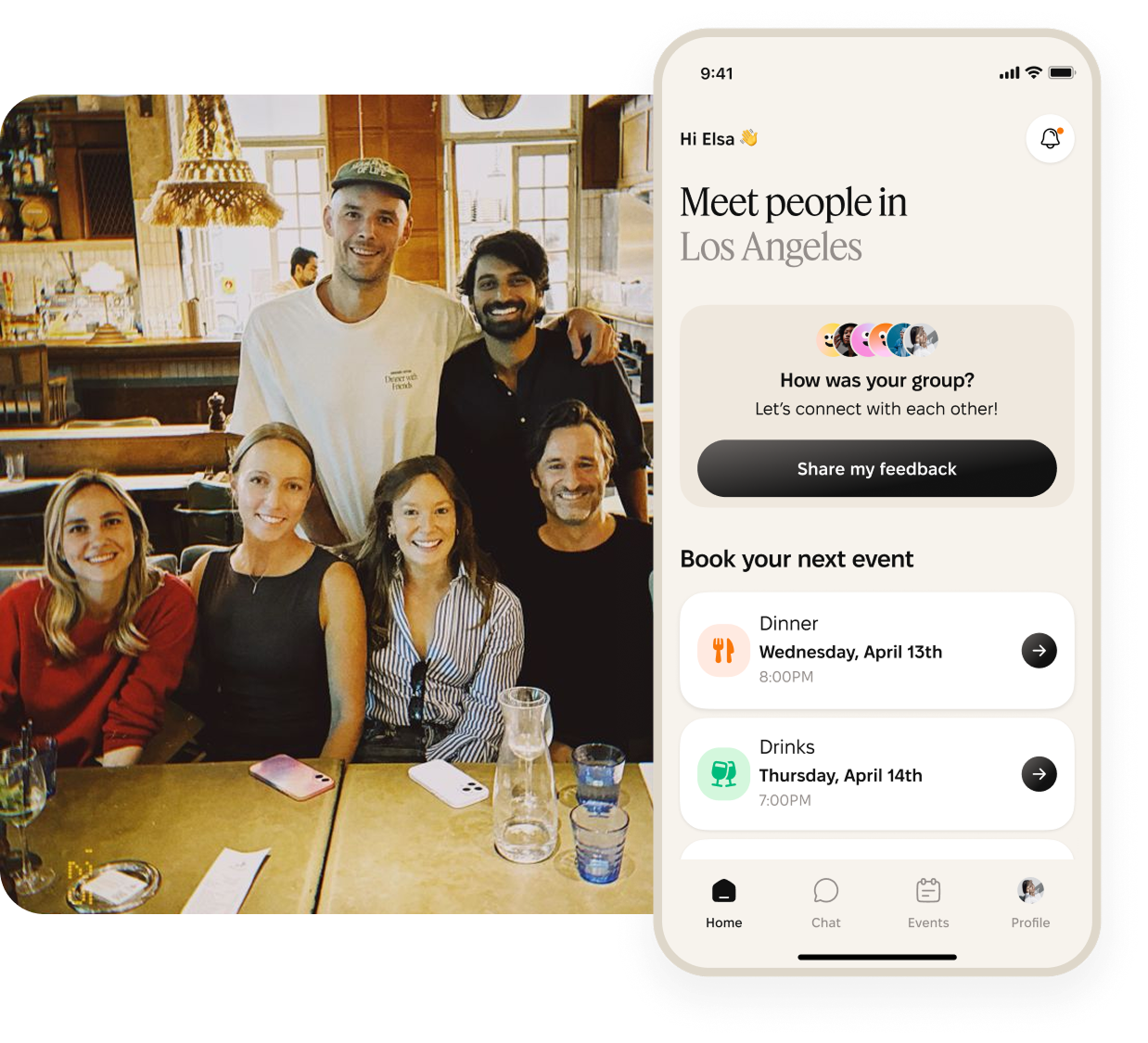
That last one is where something like Timeleft comes in, a weekly social experience (dinners, drinks, coffees, runs) planned for you around exactly the conditions that make connection more likely: small groups of people, a structured format, and the same opportunity available every week. No swiping, or pre-existing social circle required. Just a table, a set time, and a group of people who all decided to show up, too.
Something like this is not a means of replacing the concept of a local pub, but rather an infrastructure to build the kind of social rhythm that makes a third space necessary in the first place. Plus, you might just meet the group of people who you end up meeting up with for weekly chess in the park.
Third spaces go beyond the personal
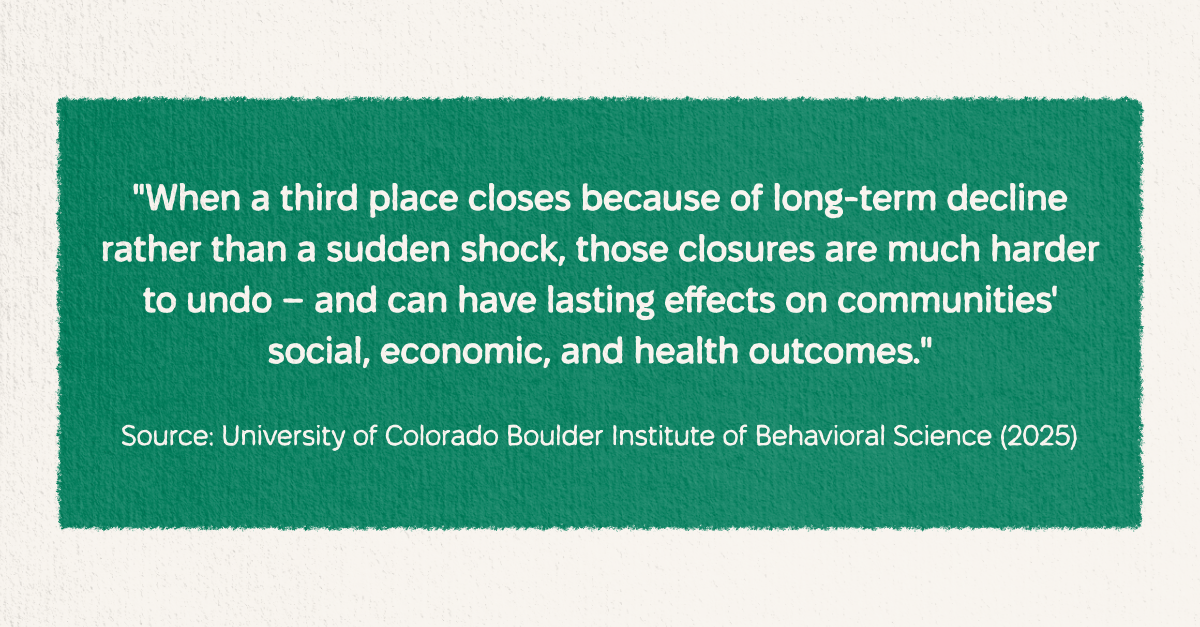
These places don't just matter for the people who enjoy them, but also for the entire cities and towns they exist in. According to the American Enterprise Institute, for much of the 20th century, the corner café, local diner, the neighborhood bar — these were the informal social infrastructure of urban and suburban life. Sites where people mixed across generational and economic lines, where people remembered the value of showing up and being present. When they go, something harder to replace goes with them.
The venues that give a city its character, the ones that feel like somewhere rather than anywhere, only exist because people keep walking through the door. Every time you choose the independent café over the drive-through app, the local pub over the sofa, the community runs over the solo treadmill, you're doing something small but real. You're keeping a place alive. And a place that stays alive keeps you more alive in it.
Showing up for your city isn't a grand gesture. It's just a small choice you can make any day of the week.
Your move
The disappearance of third spaces is unfortunate, and it's having a very real impact on how connected (or not) people feel in their daily lives. But, it's not irreversible, and it's not something you have to wait for policy or economics to fix.
You can start this week. Find a format you like, go back more than once, and bring the same energy you'd want to walk into.
Ready to find your group? There's a Timeleft dinner, drinks, coffee, or run happening in your city this week – and a recurring spot with your name on it.
[ Start your subscription ]