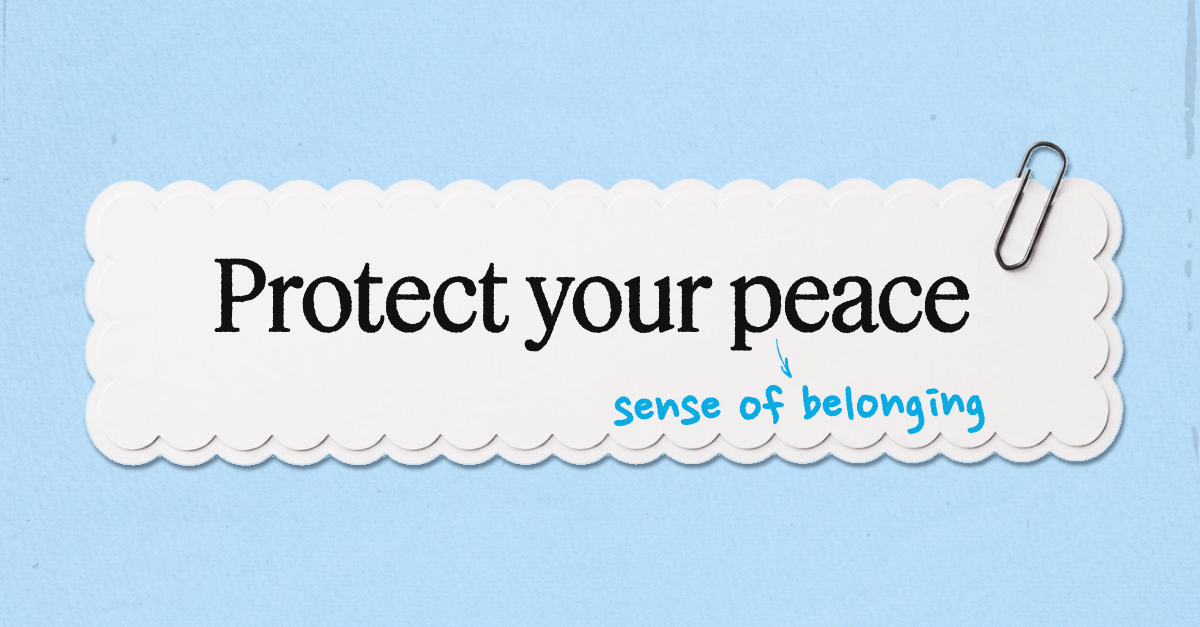
Are we “eat, pray, loving” ourselves into a lonelier existence?
For a while there, “protect your peace” was *the* social media mantra.
Feeling a bit dragged down? Say no. Set the boundary. Mute the group chat. Cut off the friend who keeps venting about her divorce at brunch. It was the go-to advice of every self-proclaimed “internet therapist” (no qualifications in sight), and a beacon of hope for us everyday folk.
It makes sense, especially when you consider the context of its arrival on the social media scene. The year was 2020 and the disillusionment with hustle culture had begun. As Laura Pitcher writes for Nylon, there was a collective realization that we were becoming more burnt out than accomplished, and a new era of protecting one’s inner peace began. At the time her piece was published, the hashtag had racked up more than 150 million views on TikTok alone.
Life is no easier now, and choosing ourselves over all else feels like a way to push back against the rising tide of negativity.
Except that, as time goes on, a self-improvement tool meant to be used sparingly can easily become a full-blown lifestyle. And the cost of that lifestyle, of never allowing yourself to be disrupted, annoyed, or slightly put out, can be pretty high.
Because your entire sense of belonging hangs in the balance.
Therapy speak has entered the chat
As Laura Pitcher explains, when hustle culture was “exposed as being a one-way ticket to unfulfillment and burnout… we gradually entered a new era of prioritizing peace”. However, this era’s rise in popularity (especially in the social media sense) didn’t happen in a vacuum. In reality, it’s just one entry in a much larger cultural shift, one that sees clinical language moving out of the therapist's office and into group chats, captions, and comment sections.
“Gaslighting”. “Trauma response”. “Toxic”. Words that carry quite precise clinical weight are now doing double duty as everyday shorthand, and The Mancunion points to “protect your peace” as one of the clearest examples.
This terminology being used in more everyday contexts isn’t necessarily a bad thing – it points to mental health becoming more accessible, as well as helps to destigmatize mental health issues, and brings to light the need to speak about them.
As clinical psychologist Dr. Isabelle Morley told Scripps News, the real issue isn't how much they’re being used so much as a transition we haven’t figured out yet: how to take language designed for a therapist's office and use it in daily life without losing what it actually means. In other words, a phrase meant for something specific and situational, like guarding your energy after a genuinely draining interaction, ends up covering even the most minor of daily inconveniences.
The vibe shift, explained
To be clear: none of this is an argument against walking away from things that are genuinely harmful.
It's more about what happened when boundary-setting got glamorized into a trend. As culture writer Maybelle Morgan points out in this piece for Dazed, it ended up promoting “avoidance rather than tools for healthier connection.” Boundaries became less about protecting yourself from something specific and more about never having to deal with anyone else's mess. Period.
And that avoidance has a price tag. As organizational scientist Andrea Carter writes in The Conversation, digital life has sold us a version of connection with none of the actual cost – comfort without ever having to consider anyone else, belonging without the mutual accountability that used to come standard. It's a good deal, right up until you notice what you're not getting in return: the actual relationships that cost required in the first place.
The data backs it up. A study published in Frontiers in Psychology, which tracked 166 countries between 2019 and 2024, found that people's ability to read and manage emotion had dropped by 6% over that period, per The Week. That number matters more than it sounds like it should, because Carter cites a related figure: people with stronger emotional intelligence are more than ten times as likely to have solid relationships and a real sense of wellbeing. So the very skill we're losing is the same skill that predicts whether we feel connected at all.
We didn't just optimise our commutes
So far, we’ve mostly touched on language, the words we reach for to explain why we're opting out. But there's a bigger force sitting underneath all of it: convenience culture. This refers to the steady, decades-long project of removing friction from everyday life – one-click checkout, same-day delivery, swiping instead of talking. It's made almost everything easier, while also quietly training us to expect that ease everywhere, including from other people.
That expectation snuck into places that are a lot more personal than your commute, and the bill shows up there too. Dating, for one. Writing in Glamour, Hena Bryan noted that women setting firmer emotional boundaries has, for some, made it harder to build the kind of lasting connection that requires both people showing up equally. Being alone starts to feel safer than being let down. Which, fair. But also: lonely.
Family isn't immune either. Across North America, as many as 130 million people describe themselves as estranged from a relative, more than a third of them from someone in their immediate family, according to The Harris Poll. Some of that estrangement is necessary and overdue. Some of it is a boundary that slowly calcifies into a wall, applied to a person who once just annoyed you at Thanksgiving rather than actually harmed you. Either way, the price is the same: one less person in your corner.
None of this is to say that one should stick around in a situation that harms you, but rather a case for noticing when “protecting your peace” has become a permanent setting instead of an occasional tool, and checking in on what that setting is actually costing you.
The inconvenient truth about connection
The unglamorous truth is that connection gets built by actually showing up for people, especially when it's annoying. Every time you opt out of that, you're not just avoiding a mildly annoying afternoon.
As Carter puts it: community isn't built through connection alone, it's built through interdependence, and interdependence, by design, is inconvenient, “a human infrastructure that is deliberately inconvenient.” In other words, belonging was never supposed to feel like fitting in without friction. It was always going to cost you something. The only real choice is whether you pay it in inconvenience, or pay it in loneliness later.
Harvard's long-running Study of Adult Development, one of the most extensive studies of human life ever conducted, has tracked its subjects for eight decades and found that how good our relationships are matters more for a long, happy life than genetics does, according to Harvard. Not our income. Not our cholesterol. Who shows up, and how often, and whether we let them.
So maybe the goal isn't to abandon boundaries altogether. There's still room for both self-care and looking out for each other. But peace that costs you every messy, inconvenient, occasionally annoying relationship in your life isn't really peace.
Let something inconvenience you this week
So yes, sometimes your inner peace could be a little less protected. Text the friend back even though you're tired. Go to the birthday dinner across town on a Tuesday. Sit with someone's bad day instead of muting it. None of it is efficient. All of it is the actual cost of admission to a full and beautiful life, with your people in your corner.
So ask yourself: would you rather be slightly inconvenienced, or lose your sense of belonging entirely?