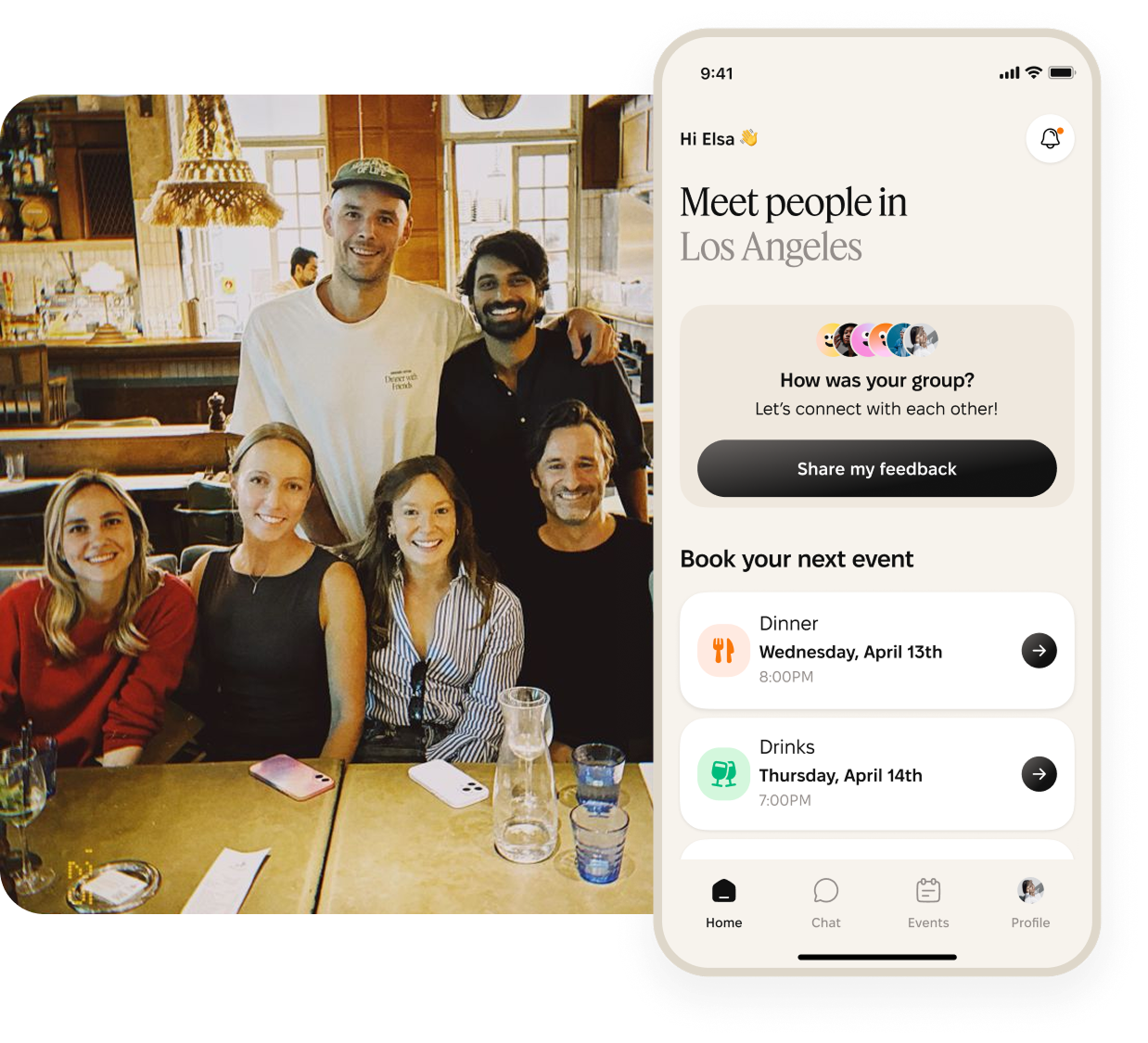
A dinner with strangers is a planned meal - usually at a local restaurant - where a small group of people who've never met share food, conversation, and an evening together. Modern versions like Timeleft match six guests by personality and seat them at a curated restaurant every Wednesday in 200+ cities.
It can sound unusual at first. Who shows up? What do you talk about? Is it fun, or just plain awkward? With severe loneliness tripling since the pandemic and the US Surgeon General calling social disconnection a public health crisis, sharing a meal is one of the simplest, most-proven ways to turn strangers into friends.
This guide walks through exactly how it works, what to expect, and why more than three million people have now tried social dining with Timeleft - and why so many book a second table.
What is dinner with strangers (and why it's having a moment)
A dinner with strangers is exactly what it sounds like: sharing a meal with people you've never met. Usually it's hosted at a local restaurant, with a small group of four to eight guests who come together for a single evening of food and conversation.
The format feels modern, but the concept isn't new. Shared meals have long been one of the simplest ways humans build relationships, from traditional communal feasts to more recent supper clubs and hosted dinners.
What's new is the demand. Severe loneliness has tripled since the pandemic. The US Surgeon General issued an advisory in 2023 comparing the health impact of chronic loneliness to smoking 15 cigarettes a day. The WHO Commission on Social Connection now treats it as a global public health priority. More and more adults are actively looking for ways to meet people in real life - not on a screen.
There's good reason that a shared meal specifically turns strangers into friends. Research shows that even small interactions with strangers can increase happiness and belonging, but it's food that does the bonding work. As Jennifer Verdolin, PhD writes in Psychology Today:
"Research shows that after just a single food sharing event, the levels of circulating oxytocin are higher and promote social bonding and higher levels of cooperation."
That's the gap structured social dining fills. Timeleft is The Friendship App - connecting strangers over weekly dinners, drinks, coffees, and runs in 200+ cities across 52 countries worldwide. Founded in 2020, Timeleft has now seated more than 3 million guests at curated tables around the world.
"Literally something as simple as chatting with a group of strangers with the same intentions of making new friends, socializing, bantering, was exactly what I've been needing living in a post-pandemic, disconnected, and isolated city." - J., 5★ (California)
Dinner with strangers is no longer a niche idea. It's a global social format designed to make meeting new people feel simple, relaxed, and natural. If you already feel like this might be for you, you can book your first dinner with Timeleft.
Dinner with strangers vs. other social dining formats
People often confuse dinner with strangers, supper clubs, dinner parties, and social dining apps. They overlap - but each has a distinct shape. Here's how the most common formats actually compare.
The main differences are who curates the table, how people are matched, and what the evening is designed to produce. A supper club is about the food and the host. A DIY dinner party is about your social graph. A Timeleft dinner is built specifically to turn six strangers into people who actually want to see each other again - with the planning removed.
What actually happens at a dinner with strangers
One of the biggest questions people have is simple: what does the evening actually look like? At Timeleft, the format is designed to be straightforward and low-pressure. From booking to dessert, the structure removes the awkwardness while leaving room for natural connection.
Here's what a typical evening looks like.
1. Book your dinner
It starts with choosing a Wednesday dinner in your city. No bios, no swiping. You answer a few short questions, and Timeleft's personality-matching algorithm pairs you with five like-minded strangers, then picks a partner restaurant suited to the group's vibe, location, and budget.
Why a table of six? It's the sweet spot - small enough to hear everyone, big enough to keep the conversation lively and dynamic.
2. Get your table assignment
In the days before the dinner, you'll get all the details - the restaurant, the time, what to expect on arrival. Timeleft works with local restaurant partners in 200+ cities across 52 countries, chosen specifically because they're good for small-group conversation. Nearly 80,000 New Yorkers alone have already booked a seat at a Timeleft table, and the format grows each week.
3. Arrive and meet your group
Most dinners include six guests who are meeting for the first time. The first few minutes tend to look the same everywhere: people introduce themselves, order a drink, and start with the easy opening questions - where you're from, what brought you here tonight, how you heard about this. Everyone signed up for the same evening, so there's already shared context. No one is interrupting an existing friend group or trying to break in.
4. Conversation cards guide the table
To help the evening flow, many tables use conversation cards - light, open-ended prompts that make it easier to move beyond small talk. Think travel, unexpected life stories, or memorable experiences.
They're a great way to get things moving, but they're also optional. Some tables use them all night, others never touch them and let the conversation go where it wants.
5. The evening unfolds
Most dinners run about two hours - roughly what you'd expect from any other restaurant meal. Food arrives, stories get shared, the initial nervousness dies down, and the table starts to feel less like six strangers and more like a group of friends hanging out. Some tables continue afterward with optional Last Drinks nearby. Others wrap at the door. There's no right answer.
6. Stay in touch - your choice
At the end of the night, guests often swap numbers or connect on socials, but there's no expectation that everyone becomes close friends. Sometimes the outcome is an interesting evening and a few new perspectives. Other times, people make plans to meet again.
Beyond dinners, Timeleft also hosts drinks, coffee meetups, and group runs - more ways to show up again for anyone who liked the format.

"I've been to four dinners and every one was a non-stop conversation. I'm an introvert who is nervous to meet new people but I have been shocked at how natural and comfortable it has been." - Michele R., 5★ (US)
"But won't it be awkward?" - honest answers to your biggest fears
Even the most curious guests wonder if dinner with strangers will feel… well, awkward. Here's how the most common worries actually play out.
Q: What if I have nothing to say?
A: Conversation cards are there to spark light, fun, and sometimes surprisingly meaningful discussion - so those dreaded uncomfortable pauses rarely happen. Most guests tell us the first ten minutes are the hardest, and then the table carries itself.
Q: What if I don't like anyone at my table?
A: Timeleft uses a personality-matching algorithm to create compatible groups, and each week pulls from a different slice of the city. If one table doesn't click, the next one often does. Many guests say the biggest surprise is meeting someone they'd never have crossed paths with otherwise.
Q: What if I'm the only one who's nervous?
A: You won't be. Almost everyone is a little anxious at the start - that's kind of the point. The shared nerves are what make the table feel like a group quickly.
Q: Is it safe?
A: Yes. Timeleft vets every restaurant partner, meetups happen in public venues, and no personal information is shared unless you choose to.
Why people keep coming back
Timeleft isn't a one-off experiment for most guests. Its 4.8-star app rating reflects members who return - many show up for more than one dinner a month. What starts as curiosity often turns into a weekly ritual.
Part of the appeal is the mix. With more than 3 million guests across 200+ cities and 52 countries, each table tends to bring together a range of ages, professions, and backgrounds - the kind of combination that keeps the conversation fresh. People start as strangers, become friends, and occasionally find something more.
"As nervous as I was, I thoroughly enjoyed it. It's given me so much confidence to speak to anyone anywhere and since then I've made sure to do at least 2 a month." - Morganjay981, 5★ (UK)
"I've attended a couple of Timeleft dinners and have met and connected with some great people. The restaurants have been nice and the conversations have flowed within the group. It's a nice, low-pressure way to meet new people and connect." - Amy C., 5★ (US)
"I love the diversity of people I would never meet in my daily life. Met everything from firework experts to astrophysicists so far." - Nick, 5★ (US)
There's also a reason return visits matter more than a single night. The research on friendship is clear: Hall's 2018 study found it takes roughly 50 hours to turn an acquaintance into a casual friend, 90 to reach friend status, and 200 for a close friendship. That's a lot of evenings - but it starts with one. Practice the friendship you're looking for, and the hours stack up faster than you'd think.
How to have the best dinner with strangers experience
A few simple habits make the first (or tenth) evening easier.
Arrive with an open mind. Everyone is there to connect, just like you. Expect curiosity, not judgment.
Ask questions and listen. Optional conversation cards help get things flowing.
Be yourself. Relax and let your personality show - the algorithm already did the filtering.
Dress confidently. Casual, smart, or a little bit extra. Whatever makes you feel at ease is right.
Arrive on time. Punctuality helps the group start on the same note, together.
Come to enjoy the meal. Think of it as sharing a fun evening - not performing, not networking.
Those six habits, repeated, are how you move from "I went to a dinner with strangers once" to "these are people I see on purpose now."
Dinner with strangers in your city
Timeleft dinners are happening all over the world, so you rarely have to travel far to try one. Popular cities include New York, Paris, Los Angeles, Mexico City, London, and Taipei.
To find a dinner near you, browse all the cities where Timeleft gathers. Whether you're in a major metro or a smaller one, there's likely a table close by.
"I had my first Timeleft experience at Mavs in Geelong, and it was hands down one of the most memorable nights out I've ever had. The food was delicious, but the real highlight was the amazing group I got to spend the evening with. We were perfectly matched - every single person was kind, caring, and just there to connect and share openly." - Pete, 5★ (Australia)
If you're looking for more ways to meet people locally, Timeleft's guide to making friends as an adult and its city-specific guide to making friends in New York are both good next reads. For further reading, compare the best apps to make friends or read what to do if it feels like you have no friends.
FAQ: Dinner with strangers
What is dinner with strangers?
A dinner with strangers is a planned meal where a small group of people who have never met - usually four to eight guests - share an evening at a local restaurant or private home. Modern formats like Timeleft use personality matching to build tables of six and handle the restaurant booking, so guests just show up and eat. The point is simple: turn strangers into friends, one shared meal at a time.
What is the app where you meet strangers for dinner?
Timeleft is the app most people mean. It matches six personality-compatible strangers for a weekly Wednesday dinner at a curated local restaurant, in 200+ cities across 52 countries. There's no swiping, no bios, and no planning - you answer a few questions, and Timeleft handles the rest.
Is dinner with strangers safe?
Yes. Meetups happen in public, vetted restaurant partners. No personal information is shared between guests unless they choose to exchange contact details. Timeleft's 4.8-star app rating and more than 3 million guests across 200+ cities is, at this point, a fairly strong safety track record.
What's the difference between a supper club and a dinner with strangers?
A supper club is usually hosted by one chef or organizer, held in a home or pop-up, and often focused on the food. A dinner with strangers (in the Timeleft sense) is held at a public restaurant, matches guests by personality, and is designed primarily around conversation and connection - the meal is the backdrop, not the main event.
How much does dinner with strangers cost?
Timeleft runs on a small monthly subscription - roughly the price of a couple of cocktails - which covers the matching, the reservation, and the conversation cards. Food and drinks at the restaurant are paid separately, just like any normal meal out.
Can introverts do dinner with strangers?
Yes, and many Timeleft guests self-identify as introverts. A structured table of six, conversation cards on standby, and a fixed end time tend to work better for quieter personalities than open, free-floating social events. Most introverted guests report that the format is easier than a party because the group is small and the roles are clear.