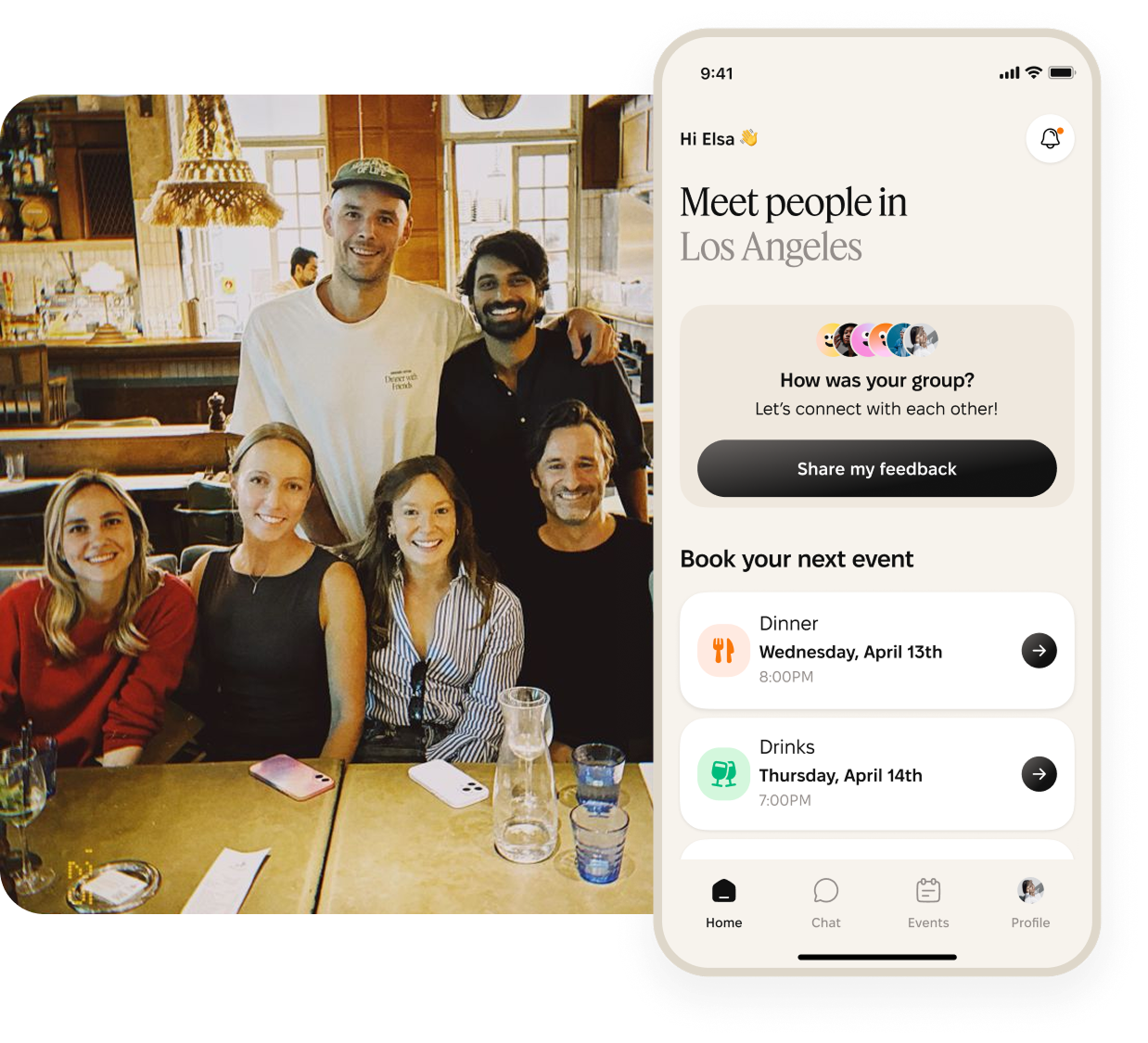
Making friends as an adult is harder than it was at school because the shared-routine infrastructure that used to create friendship by default is gone. The research is clear: it takes roughly 50 hours together to become casual friends, 90 hours for real friendship, and 200+ for a close bond (Hall, 2018). The fix isn’t more effort - it’s better environments. Choose one recurring, low-pressure space - a weekly class, a volunteer shift, a Timeleft dinner with five strangers - and keep showing up. Timeleft is the Friendship App connecting six strangers over weekly dinners, drinks, coffees and runs in 200+ cities worldwide.
At some point in your twenties or thirties, something starts to feel a bit off.
Nope, we’re not talking about the aching knees, the sudden inability to digest dairy and gluten, or the impulse to sign up for a marathon (although all of these are also true).
We’re talking about the realization that creeps up on you, often in the middle of the night or mid-scroll, that making friends is starting to feel weirdly difficult.
At school, university, or early jobs, you didn’t really have to think about it. You were surrounded by the same people every day, sharing routines, experiences, and even boredom. Friendship was built into your day-to-day life.
Then, as you get older, those structures slowly start disappearing. People move. Relationships change. Schedules fill up. Meanwhile, modern life and convenience culture have quietly optimized away the opportunity to meet people by chance.
Just like that, making new friends becomes something you have to figure out from scratch - no manual, no YouTube tutorial in sight.
Cue the internal alarm bells.
The usual advice (“You just need to put yourself out there more” or “Join a club, sweetie - that’s what we did in my day!”) is nice and all, but the reality is far more daunting. You can pluck up the courage to go to something, have a few polite conversations, maybe even enjoy it - and still come away with nothing. No follow-ups, no real connections, no new friends.
It sucks.
If this sounds familiar, and you find yourself wondering “What am I doing wrong?” - you’re not the problem.
Making friends as an adult is hard because we now have to actively seek out the infrastructure to meet people.
The good news? It’s easier to build that infrastructure than you think. This guide will show you how: practical ways to meet new people, the science behind what turns a stranger into a friend, and how to get those initial introductions to turn into something real.
Why making friends as an adult is so hard (it’s not just you)
The short answer: three conditions made friendship almost automatic when you were younger, and all three quietly disappeared.
1. You saw the same people all the time. At school, university, and early jobs, your life was built around repeated exposure. You didn’t have to plan to see people - they were just there.
2. You had shared experiences by default. Classes, deadlines, mutual friends, even just being in the same place at the same time meant you always had something to talk about.
3. Interaction was low-pressure and frequent. Small, casual chats happened often enough that no single conversation had to “matter.”
What changes in adulthood
As an adult, those conditions slowly fall away as you:
Start working remotely or in a smaller team
Move to a new city where you don’t know anyone
Have a schedule that needs planning weeks in advance
Spend more time in one-on-one or transactional interactions
Because of this, friendship starts to feel like something you opt in to, instead of a natural part of your day. Most social interactions become one-off (you meet someone once and never again), unstructured (no clear reason to follow up), or high-pressure (it feels like you need to click immediately).
That’s a tough environment for friendship to grow in.
This isn’t just a personal experience
Research from the Survey Center on American Life shows that adults today report having fewer close friends than previous generations. In 1990, 33% of Americans said they had ten or more close friends; by 2021, that number had fallen to 13%. Twelve percent of Americans now report having no close friends at all - a fourfold increase over three decades.
The US Surgeon General has called loneliness a public health crisis, noting that chronic loneliness carries a mortality risk comparable to smoking 15 cigarettes a day. The WHO Commission on Social Connection estimates that 1 in 4 older adults and 1 in 7 adolescents worldwide experience social isolation.
In other words, loneliness is a systemic problem, not a personal failure. You’re not behind or bad at friendship - you’re trying to meet people in a world that doesn’t prioritize human connection anymore.
So: what does it actually take to turn a stranger into a friend? And how long does it really take?
The science of friendship: what research actually says
If you’ve ever felt like making friends used to happen faster, you’re not imagining it - and there’s a simple reason for that.
It comes down to time and repetition. One of the most cited friendship studies is Hall (2018), which tracked adults moving to new cities and found:
Fifty hours sounds like a lot until you realize a weekly two-hour dinner for six months clears the first threshold.
Besides time, sociologists name three core ingredients in robust friendships:
1. Proximity - you’re in the same place regularly.
2. Repeated interaction - you see each other again and again.
3. A bit of vulnerability - conversations move beyond the surface.
Where people get stuck
Most adult socializing misses at least one of these. You might:
Meet someone once at a gathering (no repetition)
Chat occasionally at work (no depth)
Have a great conversation with a stranger (no follow-up)
That’s why it can feel confusing. You might find yourself thinking: "We got along, so why didn’t it turn into anything?"
The takeaway: friendship is less about finding the right people in a single moment, and more about spending enough time with them in the right conditions that something meaningful has a chance to grow.
So - where do you actually find those conditions in real adult life?
7 proven ways to make friends as an adult
There's no one-size-fits-all answer, but a handful of environments consistently create the three conditions we just named: repetition, proximity, and low-pressure interaction.
The best part? You can try the ones that speak to you this week.
1. Join structured social activities
Think sports leagues, book clubs, group classes, or curated gatherings like Timeleft.
Why it works: you don't have to force the connection because the structure is doing it for you. You see the same people again, naturally.
How to start this week: Pick one recurring activity (weekly class, club, or gathering) and commit to showing up at least three times before deciding if it's for you. You can also book your first Timeleft dinner - there's one happening every week. If you connect with someone, you can bring them along to the next one.
"I'm an introvert and I'm surprised at how easily I opened up to everyone at the dinners I've attended. It's been a great way to meet people and get to know the city." - Simone Gibbs (4★, US)
2. Go where people share an interest
A pottery class, a running club, a language course - the activity does half the social work for you.
Why it works: shared context makes conversation easier. You already have something in common, so connection doesn't lean on small talk.
How to start this week: Search for one local hobby group (running club, language class, creative workshop) and show up once - even if you feel slightly out of place at first.
3. Use friendship-focused apps and platforms
Instead of hoping for a chance encounter, step into a space designed for real connection.
Why it works: apps like Timeleft or Bumble BFF remove one of the hardest parts - figuring out where to meet people in the first place.
How to start this week: Download one app and sign up for something in the next 7–10 days. Leave the imposter syndrome at the door. 3M+ people across 200+ cities have already booked a Timeleft gathering to turn strangers into friends.
"If you're new to a city or looking to make new friends, it can be REALLY hard to start from zero. Timeleft takes all the sting out of that first step by grouping you with other people who want to meet people. By the end of the night we had set up a group chat and made plans for the weekend." - tnxw333 (5★, US)
4. Become a regular somewhere
Show up to your local spots repeatedly. No degree in professional networking required.
Why it works: familiarity builds trust. Brief interactions become easier when they happen repeatedly with the same people.
How to start this week: Choose one place you already go (gym, café, coworking space) and commit to going at the same time and day for a few weeks.
5. Volunteer for something you care about
Working on yourself and your community - a rare win-win.
Why it works: when you're not trying to impress someone, the social pressure falls away. Conversation flows more naturally when you're focused on a task.
How to start this week: Find one local volunteer opportunity in your neighborhood, sign up for a single shift, and get to work.
6. Say yes more often
Sometimes you don't have to organize a thing to step into a new social circle - just say yes when an invite comes your way.
Why it works: friendships need repetition, and agreeing to go to something increases the number of repeat social touchpoints you get in a short time.
How to start this week: Accept at least one social invitation you'd normally decline. The further out of your comfort zone, the better.
7. Rekindle dormant connections
Sometimes the easiest "new" friends are actually old ones.
Why it works: shared history lowers the barrier to rebuilding. You're not starting from zero.
How to start this week: Message one person you've lost touch with and suggest something easy you used to enjoy together - a walk, a coffee, a catch-up. The reply rate is higher than you think.
A rough map of which environments do what
Not every environment delivers on all three friendship conditions equally. Here's how the most common options stack up, based on what we see across Timeleft gatherings and the research on friendship formation:
The pattern is clear: environments that schedule repetition for you beat environments that require you to engineer it yourself.
How to turn acquaintances into real friends
Even if you don't struggle to meet people, you might still find it hard to turn those moments into a meaningful connection.
Imagine this: a great conversation at a gathering, at work, or at a dinner - then nothing happens. No follow-up, no second hangout. That's usually the missing step.
The "second hangout" problem
Much like dating, friendship needs a second date (and a third, fourth, and fifth). Most people assume that if you click, you'll naturally meet up again. Unfortunately, that's rarely how it works in adulthood because nothing is structured to bring you back together.
The goal is simple: be intentional, and make the second hangout happen on purpose.
Make the follow-up feel easy
You don't need a perfect message. Something light and specific works a charm:
"I enjoyed chatting last night. Want to grab a coffee sometime this week?"
"Are you going to that again next week? I might go too."
"We should continue that conversation over a drink sometime."
Short, sweet, low-pressure.
Use repetition, not pressure
One-off, vague plans feel fragile. Recurring plans do the hard work for you.
Instead of:
"Let's hang out sometime."
Try:
"I'm going again next week - join if you're keen."
That repetition is what turns strangers into acquaintances, and acquaintances into friends.
Don't wait for momentum - create it
A common trap is waiting until you feel close enough to suggest something. Closeness usually comes after time together, not before. A better rule: if you enjoyed talking to someone, suggest the next meet-up quickly, while it's still fresh - even if it feels slightly early.
"There are no strangers here, only friends you haven't met yet." - William Butler Yeats
How to make friends in specific situations
Making friends as an adult doesn't look the same for everyone. Where you are in life changes what's possible - but the underlying principle stays the same: repeated, low-pressure interaction with the same people over time.
Here's how that plays out in different situations.
If you've just moved to a new city
What's hard about it: you're starting from zero. No shared context, no familiar faces, a low-grade sense that everything feels temporary.
What helps: prioritize frequency over variety. It's better to see the same few people repeatedly than to keep trying new one-offs.
How to start this week: Pick one or two recurring spaces (weekly class, group workout, coworking space) and commit to showing up consistently for a month. If your city is one of Timeleft's 200+, your first dinner with five strangers gets you to the first social touchpoint in under a week.
If you're introverted
What's hard about it: large social settings can feel draining, and small talk doesn't come easily.
What helps: smaller, structured environments where conversation has a natural focus.
How to start this week: Choose one low-pressure recurring activity - a book club, a quiet hobby group, or a Timeleft dinner where conversation cards do the icebreaking for you. Aim for consistency, not intensity.
If you're in your 30s or 40s
What's hard about it: everyone is busy, routines are fixed, and spontaneous socializing is rare.
What helps: scheduled, recurring social time that doesn't rely on last-minute energy or availability.
How to start this week: Block one evening a week for something social and treat it like a standing commitment, not something you fit in if you have time.
If you're a parent
What's hard about it: time is limited, and most social energy goes into family life.
What helps: micro-connections that build slowly through repeated exposure -school runs, kids' activities, local community groups.
How to start this week: Focus on one repeat touchpoint (school pick-ups, weekend activities, local parent groups) and aim for small, consistent conversations rather than big social plans.
If you've felt lonely for a long time
What's hard about it: it can feel like everyone already has their circle, and starting from scratch feels intimidating.
What helps: low-pressure environments where you're not expected to perform socially. Just show up and repeat.
How to start this week: Choose one structured social format and commit to attending three or four times before judging whether it's working. If the loneliness has been wearing on you, this guide to the modern-day isolation crisis is worth a read before you go.
The common thread
Different situations, same principle:
Friendship doesn't come from one good interaction - it comes from repeated ones.
Once you start designing your social life around that idea, everything becomes more predictable, and a lot less overwhelming.
The best apps and tools for making friends in 2026
The "chronically online" era is part of what commentators now call the Friendship Recession. But digital tools can also play a positive role - when used correctly. Friendship apps remove friction and help you meet new people in the first place. The trick is picking ones designed for real-world time together, not endless in-app messaging.
That's where Timeleft comes in
Timeleft is the Friendship App - connecting six strangers over weekly dinners, drinks, coffees and runs in 200+ cities worldwide.
Instead of relying on swiping or one-off meet-ups, we've built something more structured and repeatable:
Groups of six compatible strangers, matched by personality and interests
Weekly in-person gatherings designed for real connection, with conversation cards to break the ice
A low-pressure setting where you're not performing - just meeting people who could become your new closest friends
Built-in features for repetition, so friendship can actually grow over time
Nearly 80,000 New Yorkers alone have booked a Timeleft gathering. All you have to do is book your first dinner and show up. We handle the rest.
If you want a sense of what that first night is actually like, here's how to show up for a dinner with strangers.
Frequently asked questions
How long does it really take to make a friend as an adult?
Research from Hall (2018) found that it takes roughly 50 hours of time together to move from acquaintance to casual friend, 90 hours to become real friends, and 200+ hours for a close friendship. In practical terms, a weekly two-hour recurring hangout clears the 50-hour mark in six months. What matters isn't how often you meet, but that you keep meeting - repetition beats intensity.
What is the 11-3-6 rule of friendship?
The 11-3-6 rule is an informal framework suggesting adults should aim for roughly 11 casual friends, 3 close friends, and 6 "life" relationships (including family) to feel socially sustained. It isn't peer-reviewed science, but it echoes research on optimal social network size - notably Robin Dunbar's layered friendship model, which points to around 5 intimate relationships, 15 close friends, and 50 good friends as a healthy upper bound.
How do you make friends if you have no friends?
Start with one low-pressure recurring environment rather than several one-off events. Options that reliably work: a weekly class, a volunteer shift, a sports club, or a structured gathering like a Timeleft dinner. Commit to showing up three to four times before judging whether it's working - most adult friendships don't click on the first meeting. If long-term loneliness has been hard to shake, this guide on rebuilding a social life from scratch is a good next read.
How do you make friends in a new city?
Prioritize frequency over variety. Pick one or two recurring spaces you can return to weekly - a gym class, a coworking space, a neighborhood café, or a Timeleft dinner with five strangers - and commit for a month before adding more. New-city friendships are built on the same 50-hour rule as anywhere else; recurring environments just get you there faster than scattered one-offs.
How do I make friends as an introvert?
Choose smaller, structured environments where conversation has a natural focus - book clubs, hobby groups, or curated dinners with conversation prompts. Avoid large networking events where small talk dominates. The research is clear that introverts form close friendships at the same rate as extroverts; they just need fewer, deeper touchpoints. Consistency with the same few people beats variety with many.
Is it normal to have no close friends in your 30s?
More common than you'd think. Survey data from the Survey Center on American Life shows that 12% of American adults report having no close friends at all - a fourfold increase since 1990. The US Surgeon General now classifies chronic loneliness as a public health crisis. You're not behind. The infrastructure for adult friendship has changed, and rebuilding it is a matter of picking one recurring environment and showing up.
The truth about making friends later in life
Making friends as an adult isn't about being more outgoing or trying harder - it's about creating the conditions for real connection to happen. Once you move past school and university, friendship stops being automatic and becomes something built through repetition, shared spaces, and small moments over time.
If you're in that phase of life where you want more connection, lean into those environments - whether that's a weekly class, a recurring group, or something as simple as sitting down at a table with new people and seeing where the conversation goes, like a Timeleft dinner in your city.
You don't need to become someone else. You just need somewhere to start.